
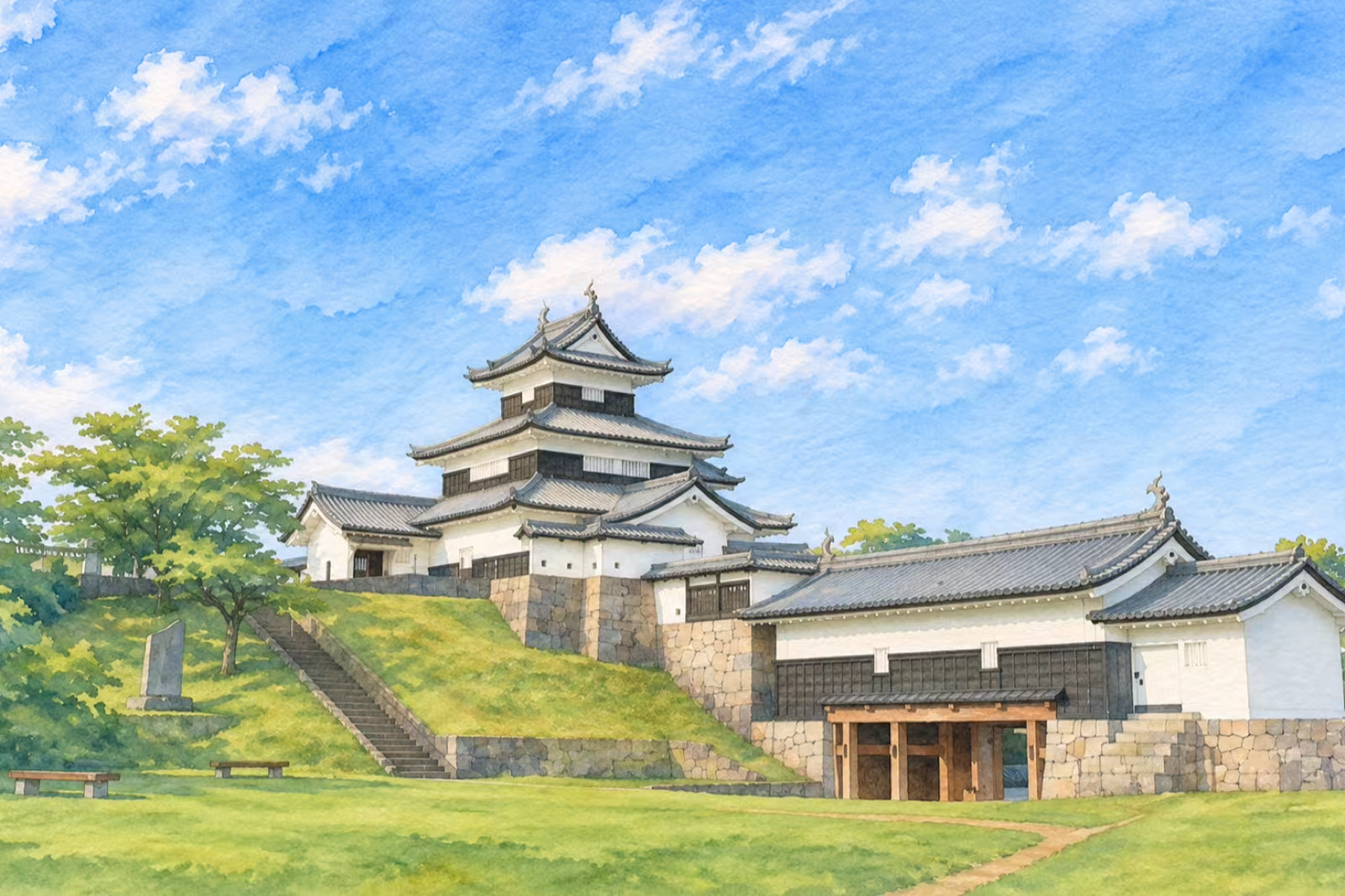
Shirakawa Komine Castle stands in the center of Shirakawa, Fukushima Prefecture. It is one of the few early-modern castles in the Tōhoku region built largely of stone walls. Shirakawa has long been the gateway from the Kantō plain into the north-east, so the castle was usually entrusted to daimyo closely tied to the Tokugawa shogunate. The three-story turret and the main gate seen today are timber reconstructions from the 1990s based on Edo-period drawings, while much of the stonework is original.
01From hill fort to castle
Tradition holds that Yūki Chikatomo of the Shirakawa Yūki family first fortified the Komine hill in the mid-fourteenth century, during the period of the Northern and Southern Courts; the castle takes its name from the hill. In 1627 Niwa Nagashige was given Shirakawa, and from 1629 he spent about four years rebuilding the site, completing a castle of stone walls and stepped enclosures around 1632. Lords changed often after that, with the Sakakibara, Honda and several Matsudaira lines among the families sent there. Matsudaira Sadanobu, who led the shogunate’s Kansei Reforms in the late eighteenth century, was himself lord of Shirakawa, and detailed drawings of the castle buildings made in his time later guided the reconstruction.
02The Boshin War
In 1868, during the Boshin War, the new government’s army and the forces of the northern domains’ alliance fought repeatedly around Shirakawa in what became known as the Battle of Shirakawaguchi. Komine Castle fell, and most of its buildings burned. After the Meiji Restoration the grounds gradually became a public park.
03What can be seen today
The three-story turret was rebuilt in 1991 and the Mae-gomon gate in 1994, both following the old drawings and traditional building methods. Some of the turret’s timber is said to come from cedar trees that still carry bullet scars from the Boshin War. The castle site was designated a National Historic Site in 2010 and is listed among Japan’s 100 Fine Castles. The Great East Japan Earthquake of 2011 brought down the stone walls in many places. Restorers recorded each stone and reused original stones wherever possible, and the main repairs were completed in 2019. As of the 2020s, work to reconstruct further gates was still under way.