
Sado is a large island in the Sea of Japan off Niigata Prefecture, today governed as Sado City. In the Muromachi period Zeami, the actor and playwright who gave Noh its classic form, was exiled here late in life. From the Edo period onward Noh took root in the island’s shrines and villages, leaving dozens of Noh stages. This heritage area brings together the places linked to Zeami’s exile and the stages scattered across Sado: two related histories separated by several centuries.
01Zeami’s exile
Zeami was the son of Kan’ami. As a young man he won the favor of the shogun Ashikaga Yoshimitsu, and he went on to write many Noh plays and treatises such as Fūshi kaden. Under the sixth shogun, Ashikaga Yoshinori, he and his sons lost the shogunate’s favor. In 1434, when he was already in his seventies, Zeami was banished to Sado. The exact charge is unknown.
According to Kintōsho, a small collection of chant texts he composed on the island, he landed on Sado’s south coast, first stayed at Manpuku-ji in Shinbo, and later moved because of fighting to Shōhō-ji in the Izumi district, in today’s Kanai area. The account in Kintōsho ends around 1436. Whether he was pardoned and returned to Kyoto, and when he died, are not firmly recorded; he is generally thought to have died around 1443.
02How Noh took root on Sado
Most of Sado’s Noh stages have no direct link to Zeami. Around 1603 Ōkubo Nagayasu came to the island as the magistrate in charge of the Sado gold and silver mines, and he is said to have brought Noh performers from Nara. Noh then spread through Sado, which was ruled directly by the shogunate. From the mid-Edo period the Hōshō school became dominant, and villagers themselves performed ritual Noh, known as shinji-nō, at shrine festivals. About 30 Noh stages survive on the island, generally said to be roughly a third of all surviving Noh stages in Japan.
03What can be seen today
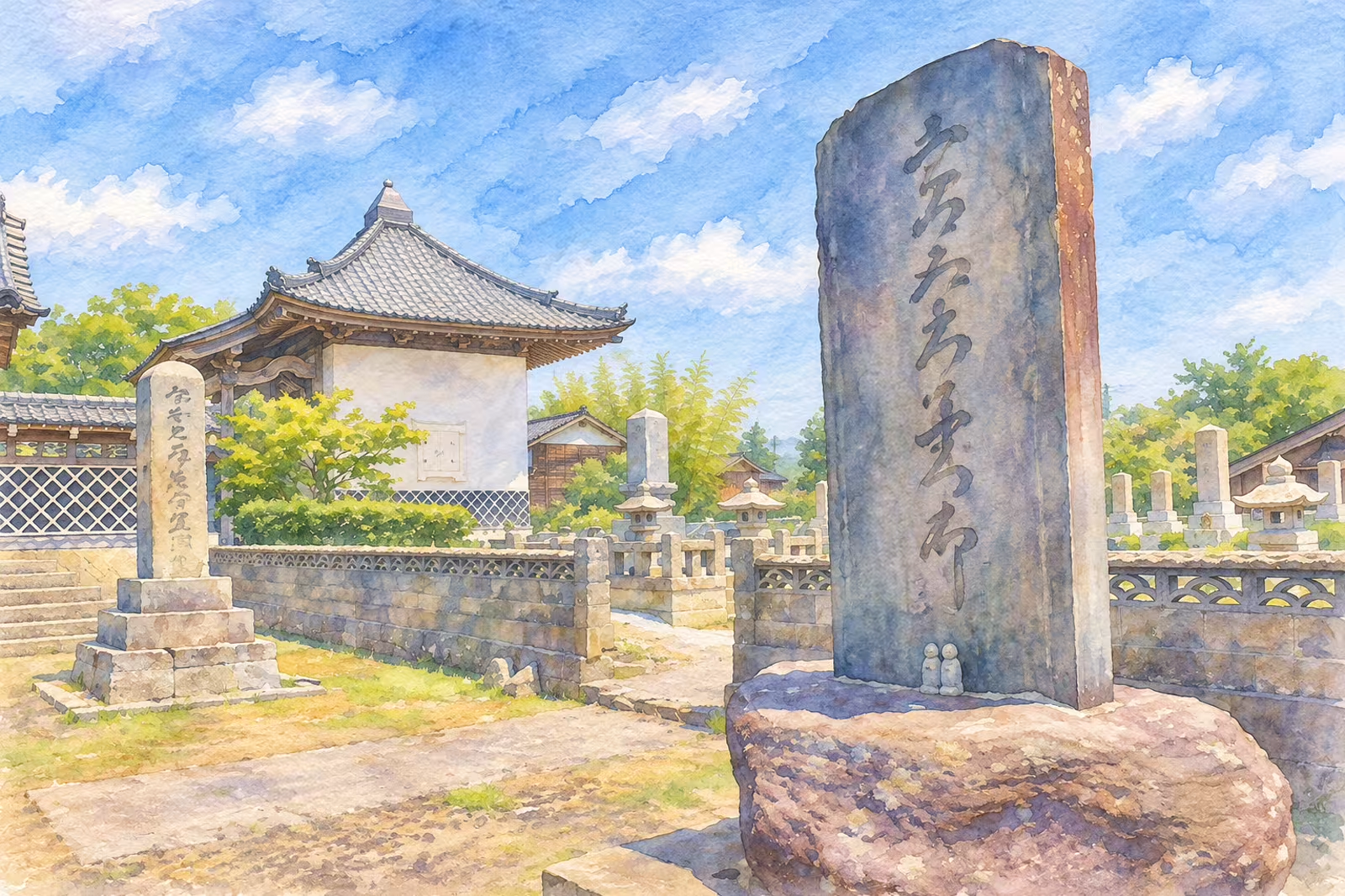
Shōhō-ji is regarded by tradition as Zeami’s residence. The temple keeps an old mask called the Beshimi ritual mask, which Zeami is said to have worn in a rain-making dance; this story rests on temple tradition alone. A memorial marker also stands near the former site of Manpuku-ji.
Representative stages include the Daizen Shrine stage (rebuilt in 1846, with a thatched roof), the Honma family stage at Katagami (the island’s only privately owned stage, rebuilt in the Meiji period), and the Ushio Shrine stage (rebuilt around 1900). Many are designated cultural properties of Niigata Prefecture, and performances, including torch-lit takigi-nō, are still held at festivals and in summer. The Noh hall at Kanai is a modern indoor venue.