
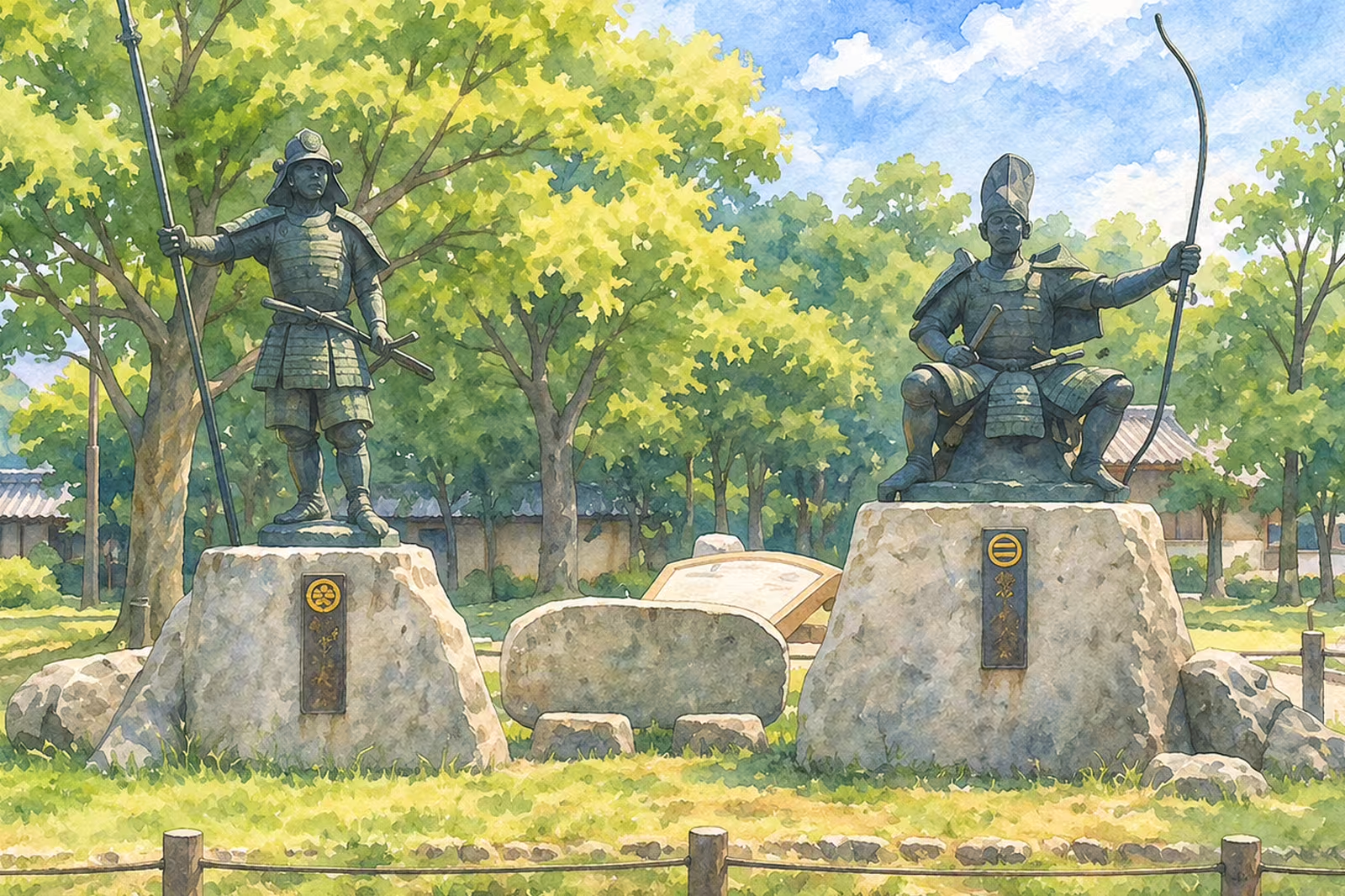
Okehazama Battlefield is the site of the Battle of Okehazama, fought in 1560 on the border between present-day Toyoake and the Midori Ward of Nagoya in Aichi Prefecture. Here Oda Nobunaga, with a small force, surprised and killed Imagawa Yoshimoto, lord of Suruga, Tōtōmi and Mikawa. The victory lifted Nobunaga from a regional power in Owari onto the path that led toward national unification. The battlefield is now suburban housing, and both Toyoake and Nagoya maintain their own "old battlefield," each with its own set of traditions.
01The battle of 1560
In the fifth month of 1560, Imagawa Yoshimoto marched west into Owari. Later accounts give his army as about 25,000 men, though some historians put it between 10,000 and 20,000. His troops took the Oda forts of Marune and Washizu, while Matsudaira Motoyasu, later known as Tokugawa Ieyasu, brought supplies into Ōdaka Castle. Nobunaga rode out from Kiyosu Castle, prayed at Atsuta Shrine, and advanced by way of the Zenshōji and Nakajima forts with only two or three thousand men. According to the Shinchō kōki, a violent rainstorm broke just before the fighting. When it cleared, the Oda force charged Yoshimoto’s headquarters group as it rested among the hills. Yoshimoto was first wounded by Hattori Koheita and then killed by Mōri Shinsuke (Yoshikatsu).
The Imagawa house declined quickly afterward. Matsudaira Motoyasu returned to Okazaki as an independent lord and allied with Nobunaga two years later. The traditional story has Nobunaga swinging around to strike from behind. In recent decades some historians, reading the Shinchō kōki closely, have argued for a frontal attack instead. Both views remain in circulation, and the exact route and the spot where Yoshimoto died are still unsettled.
02What can be seen today
On the Toyoake side, the Traditional Site of the Okehazama Battlefield was designated a National Historic Site in 1937. It holds seven stone markers, generally dated to 1771 and set up by retainers of the Owari domain. The first marks what was then believed to be Yoshimoto’s death place, and the second commemorates the Imagawa commander Matsui Munenobu. There are also grave markers for Yoshimoto from the late Edo and Meiji periods. Nearby are Kōtoku-in, said to stand on the site of Yoshimoto’s headquarters, the Senninzuka mound where the dead are said to have been buried, and the remains of Kutsukake Castle, where Yoshimoto spent the night before the battle.
In Nagoya’s Midori Ward, Okehazama Battlefield Park took its present shape around 1988. It has a marker for Yoshimoto’s death, a mound where he is said to have tethered his horse, and statues of Nobunaga and Yoshimoto added later. Temples nearby, such as Chōfuku-ji, keep their own traditions about the battle. Neither site is an untouched field. Both are the work of local communities that have marked, rearranged and remembered the battle since the Edo period.
Okehazama Battlefield
01An Afternoon That Rearranged a Region
On the nineteenth day of the fifth month of Eiroku 3 (June 12, 1560, in the Julian calendar), a rainstorm swept across the low hills of southern Owari Province, the area around modern Nagoya. When it passed, a few thousand men under Oda Nobunaga charged into the camp of a far larger army. Within hours its commander, Imagawa Yoshimoto, lord of three provinces along the Pacific coast, was dead, and his army was streaming back east.
The Battle of Okehazama is the best-known upset in Japanese military history. It made the reputation of the twenty-six-year-old Nobunaga, who would go on to dominate central Japan. It broke the power of the Imagawa house. And it freed a young hostage serving in the Imagawa army, Matsudaira Motoyasu, to return home and build his own domain. He is better known by his later name, Tokugawa Ieyasu.
A visitor to Okehazama today meets an unusual situation. There are two "Okehazama battlefields," about a kilometer apart. One, in the city of Toyoake, is a nationally designated Historic Site with a memorial grave to Yoshimoto and a row of eighteenth-century marker stones. The other, across the municipal boundary in Midori Ward of Nagoya, is a park built around a local tradition that places Yoshimoto’s death there instead. Both have a reasonable claim, and neither can be proven. Understanding why requires the story of the battle itself, and the story of how it was later retold.
02The Imagawa at Their Height
The Imagawa were a branch of the Ashikaga, the family that held the shogunate, and had governed Suruga Province (central Shizuoka today) as hereditary military governors since the fourteenth century. Yoshimoto, born in 1519, was a younger son who had been placed in a Buddhist temple as a boy. When his elder brother died suddenly in 1536, a succession war broke out, and Yoshimoto, backed by his mentor, the monk Taigen Sessai, won it.
Over the next two decades he made the Imagawa one of the strongest houses in eastern Japan. He secured his flanks through a three-way alliance with the Takeda of Kai and the Hōjō of Sagami, sealed by marriages. He pushed west into Mikawa Province and took the heir of the Matsudaira family, the child who would become Ieyasu, into his household at Sunpu as a hostage. He added articles to his father’s house law, the Imagawa Kana Mokuroku, asserting that his authority no longer depended on the shogun. Contemporaries and later writers called him the "foremost bowman of the Tōkaidō," the coastal highway that ran through his lands.
Later popular history turned him into a caricature: a soft courtly figure with blackened teeth and powdered face, too fat to ride, carried to war in a palanquin. That image owes a great deal to his defeat. In 1560 almost no one would have bet against him.
03Nobunaga and the Border Forts
Oda Nobunaga’s father, Oda Nobuhide, had risen from a junior branch of the Oda family on the wealth of the ports and temple towns of Tsushima and Atsuta, and had fought the Imagawa repeatedly in Mikawa. When Nobuhide died in the early 1550s, Owari was divided among rival Oda lines. Nobunaga spent most of the decade fighting his own relatives, including his younger brother, and by about 1559 controlled most of the province.
Meanwhile the Imagawa had gained a foothold inside Owari. Yamaguchi Noritsugu, lord of Narumi Castle, defected to the Imagawa after Nobuhide’s death, bringing Narumi and nearby Ōdaka and Kutsukake into their orbit. Yoshimoto garrisoned Narumi under Okabe Motonobu. Nobunaga responded by ringing the two enemy castles with forts: Tange, Zenshōji and Nakajima facing Narumi, Marune and Washizu facing Ōdaka. The forts cut the castles off from each other and from supply.
By the spring of 1560 Ōdaka was running short of food. In the fifth month Yoshimoto marched west in person.
04Why Yoshimoto Came
For a long time the standard explanation was that Yoshimoto meant to march on Kyoto, take control of the shogun, and rule the realm, and that Nobunaga was simply the first obstacle in his path. The idea appears in Edo-period war tales and was repeated in modern textbooks.
Most historians now doubt it. There is no sign that Yoshimoto prepared the diplomatic groundwork such a march would have needed, and the campaign looks like an operation aimed at Owari: relieving Narumi and Ōdaka, crushing the forts, and pressing the Oda hard. Whether he had larger ambitions beyond that is a matter of guesswork.
The most important source for the battle is the Shinchō Kōki (Chronicle of Lord Nobunaga), written by Ōta Gyūichi, who served Nobunaga. It gives the Imagawa army as 45,000 men, a figure most historians think inflated; estimates of around 25,000 are common. Nobunaga could put perhaps two to three thousand into the field. The imbalance itself is not in dispute.
Yoshimoto left Sunpu on the twelfth day of the fifth month and had reached Kutsukake Castle, in eastern Owari, by the eighteenth. On the night of the eighteenth, Matsudaira Motoyasu slipped a supply train into Ōdaka.
05Morning, the Nineteenth
At dawn on the nineteenth the Imagawa attacked the two forts near Ōdaka. Motoyasu’s troops took Marune, where the commander Sakuma Morishige was killed. Asahina Yasutomo took Washizu, where Oda Hidetoshi and Iio Sadamune died.
The news reached Nobunaga at Kiyosu Castle. According to the Shinchō Kōki, he chanted and danced a passage from the kōwakamai ballad Atsumori, "Man’s fifty years, compared to the realm of the gods, are but a dream and an illusion," had the conch blown, put on his armor, ate standing up, and rode out with only a handful of attendants. It is one of the most famous scenes in Japanese history, and the core of it comes from Ōta Gyūichi’s text.
He rode first to Atsuta Shrine, where he waited for his men to catch up and offered prayers, and then east along the coast road to Tange and on to Zenshōji fort, the main Oda position facing Narumi. By now he had gathered two to three thousand men. Around this time a detachment of about three hundred under Sasa Masatsugu and Senshū Suetada attacked the Imagawa vanguard on their own initiative and was cut to pieces; both commanders were killed.
Nobunaga then moved forward to Nakajima fort, which sat on low ground between two small rivers, in full view of the surrounding hills. His senior retainers grabbed his horse’s bridle to stop him. He went anyway.
06The Storm and the Charge
At Nakajima, the Shinchō Kōki has Nobunaga address his troops. The enemy, he said, had been carrying supplies and storming forts since the night before and were worn out; his men were fresh. They were not to waste time taking heads, but to cut down the enemy, leave the bodies, and keep pushing. Win, and their names would live forever.
As the Oda advanced, the weather broke. A violent storm with hail drove in from the west, into the faces of the Imagawa troops. Ōta Gyūichi records that a great camphor tree beside a pine on the pass toward Kutsukake was blown over. When the rain stopped, Nobunaga gave the order to attack. The Imagawa line gave way and fell back in confusion. Yoshimoto’s lacquered palanquin was abandoned, and he retreated surrounded by about three hundred horsemen, a guard that was worn down with each new Oda charge.
At the end, Hattori Koheita, one of Nobunaga’s mounted guards, reached Yoshimoto first and was cut across the knee. Mōri Shinsuke followed and took Yoshimoto’s head. A later account, the memoir of the warrior Mizuno Katsunari, says Yoshimoto bit off a finger of Mōri’s left hand in the struggle; the Shinchō Kōki does not mention it.
With their commander dead, the Imagawa forces collapsed. Okabe Motonobu held Narumi Castle and gave it up only in exchange for Yoshimoto’s head, which he carried back to Suruga. Motoyasu withdrew from Ōdaka and made his way to Okazaki, his family’s old seat, and did not go back.
07Surprise Attack or Head-On Assault?
The version of Okehazama most people know is a flanking raid. Nobunaga leaves Zenshōji fort, slips around behind the hills to the north of the Imagawa camp, and under cover of the storm charges down onto Yoshimoto, who is resting and drinking in a hollow called Dengaku-hazama. That picture has appeared in novels, films, television dramas and textbooks, and it is why "Okehazama" became shorthand in Japanese for a surprise attack that topples a stronger enemy.
The story’s main source is not the Shinchō Kōki but a reworking of it, the Shinchōki by Oze Hoan, published in the early seventeenth century. Hoan added drama and detail, and his book was far more widely read in the Edo period than Ōta Gyūichi’s. In 1899 the Imperial Army’s General Staff compiled a series of official battle histories, Nihon Senshi, and its volume on Okehazama adopted the flanking-attack account and presented it as a model of tactics. With that endorsement it moved into schoolbooks.
Beginning in the early 1980s, the historian Fujimoto Masayuki challenged it systematically. He pointed out that the Shinchō Kōki, written by a man who served Nobunaga, says nothing about a detour. Read plainly, it has Nobunaga leave Nakajima and advance east toward the Imagawa forward units, wait out the storm, and then attack the troops in front of him. The rout of those units spread back into the main camp. On this reading, Okehazama was a frontal assault that succeeded through timing, weather, and the disorganization of an army spread out over hilly ground. Fujimoto’s "frontal attack" interpretation is now widely accepted among specialists.
Other historians have added refinements. Some stress that the Shinchō Kōki puts Yoshimoto on "Okehazama-yama," a hill, not in a hollow. Some argue the Imagawa troops were dispersed, foraging or resting, which left the command post thinly guarded. Some suggest Nobunaga never aimed at Yoshimoto at all and simply struck the nearest enemy, with spectacular luck. These views differ from each other, but most agree that the image of Nobunaga circling behind the hills and swooping down on a drinking party lacks solid support. The tradition that a scout named Yanada Masatsuna received the highest reward after the battle for locating Yoshimoto comes from the same later line of sources.
08Where Did Yoshimoto Die?
The Shinchō Kōki names "Okehazama-yama" and nothing more precise. Okehazama itself was a village in Chita District, set in a landscape of low ridges and narrow valleys. The fighting was a running pursuit, and Yoshimoto may have moved some distance from his command post before he was killed. No contemporary source pins the spot down.
By the mid-Edo period, a low area on the Toyoake side known as Dengaku-kubo was being treated as the place of Yoshimoto’s death. In 1771, with funding from the Shimogō family of nearby Narumi, Hitomi Yaemon and Akabayashi Magoshichirō set up marker stones there to show where Yoshimoto and his leading retainers fell. These "seven stones" became the core of the commemorative site; the first of them, for Yoshimoto, is the oldest surviving marker of his death place. In December 1937 the area was designated a national Historic Site under the name "Okehazama Kosenjō Densetsuchi," which translates as "the traditional site of the Okehazama battlefield." The word "traditional" was deliberate: the designation recognized a long-standing identification, not a proven one.
On the Nagoya side, the village of Okehazama kept its own traditions: that Yoshimoto’s camp was on high ground nearby, that he fell in the village, that his head was washed at a spring and inspected at the temple of Chōfuku-ji. Local people raised a grave marker to him. This site never received national designation, but the community held to its account, and around the battle’s 450th anniversary in 2010 it was developed into the Okehazama Battlefield Park.
Both sites lie within the area the battle swept across. The sources can’t decide between them, and they may not need to.
09The Toyoake Site
The national Historic Site sits near Chūkyō-keibajō-mae Station on the Meitetsu Nagoya Line, beside Route 1. It is a small, pine-shaded plot. The centerpiece is the "Grave of Imagawa Yoshimoto," a stone set up in 1876 by Yamaguchi Masayoshi of nearby Arimatsu on a mound traditionally said to be his grave. It is not his burial place; his head was taken back east, and his graves are at temples in Shizuoka and Aichi prefectures.
Around it stand the seven marker stones of 1771, each for one of the dead, with stone number one for Yoshimoto himself, and several later monuments, among them a memorial stele raised in 1809 by Himuro Toyonaga, a Shinto priest from Tsushima. Next door is Kōtoku-in, a Shingon temple whose grounds tradition identifies as the site of Yoshimoto’s command post.
About a kilometer to the east is the Senninzuka, the "Warriors’ Mound." After the battle, according to local tradition, Kaiō Ryūki, second abbot of the nearby temple Sōgen-ji, and the villagers gathered the bodies of the Imagawa dead and buried them here. Memorial services have been held at the mound ever since.
10The Nagoya Midori Ward Site
A walk of under a kilometer west, over a low hill, brings you across the city line into Okehazama, Midori Ward, and to Okehazama Battlefield Park. Local tradition calls this spot Dengaku-tsubo and holds that Yoshimoto died here.
The park was laid out for the 450th anniversary of the battle, around 2009–2010. A terrain model reproduces the surrounding hills and marks Narumi and Ōdaka castles, the Oda forts, and the routes of both armies. A juniper known as the "Horse-Tethering Tree" marks where Yoshimoto is said to have tied his horse, and a small spring is pointed out as the place where his head was washed. Bronze statues of Nobunaga and Yoshimoto stand in the park.
In the park stands the "Sunkō Boketsu," a grave marker for Yoshimoto, "the lord of Suruga," put up by local people. Chōfuku-ji, a Pure Land temple by the pond to the south, preserves a tradition that the heads were inspected there after the battle. Temple tradition says Rin’ami, one of Yoshimoto’s attendants, dedicated its Amida image to his dead lord, and the hall keeps wooden images of Yoshimoto and his commander Matsui Munenobu.
The two cities promote their sites separately, and each holds its own annual memorial for the dead.
11Walking the Ground
Start at Chūkyō-keibajō-mae Station and visit the Toyoake site first: the memorial grave, the seven stones, then Kōtoku-in, and, if you have the energy, the Warriors’ Mound to the east. The neighborhood has been built up, so look for the slight rises and dips in the streets around the park.
Then walk west over the hill to the Midori Ward park. Its terrain model is the best place to work out what happened. Find Zenshōji and Nakajima forts, then the high ground where Yoshimoto’s camp may have stood, and the difference between the "flanking raid" and "frontal assault" versions becomes clear on the map. Then look at the spring, the juniper and the statues, and go on to Chōfuku-ji.
With more time, visit the remains of Ōdaka Castle and the Marune and Washizu forts in Midori Ward, where the fighting began at dawn on the nineteenth; they were designated together as a national Historic Site in 1938. Farther north, the sites of Narumi Castle and the Zenshōji and Nakajima forts show where Nobunaga made his last halt before the charge.
There is no grand panorama at Okehazama. The battle was fought among low ridges and small valleys, the kind of ground where an army can lose sight of itself, and where a few thousand determined men could reach a commander who thought himself well protected.