
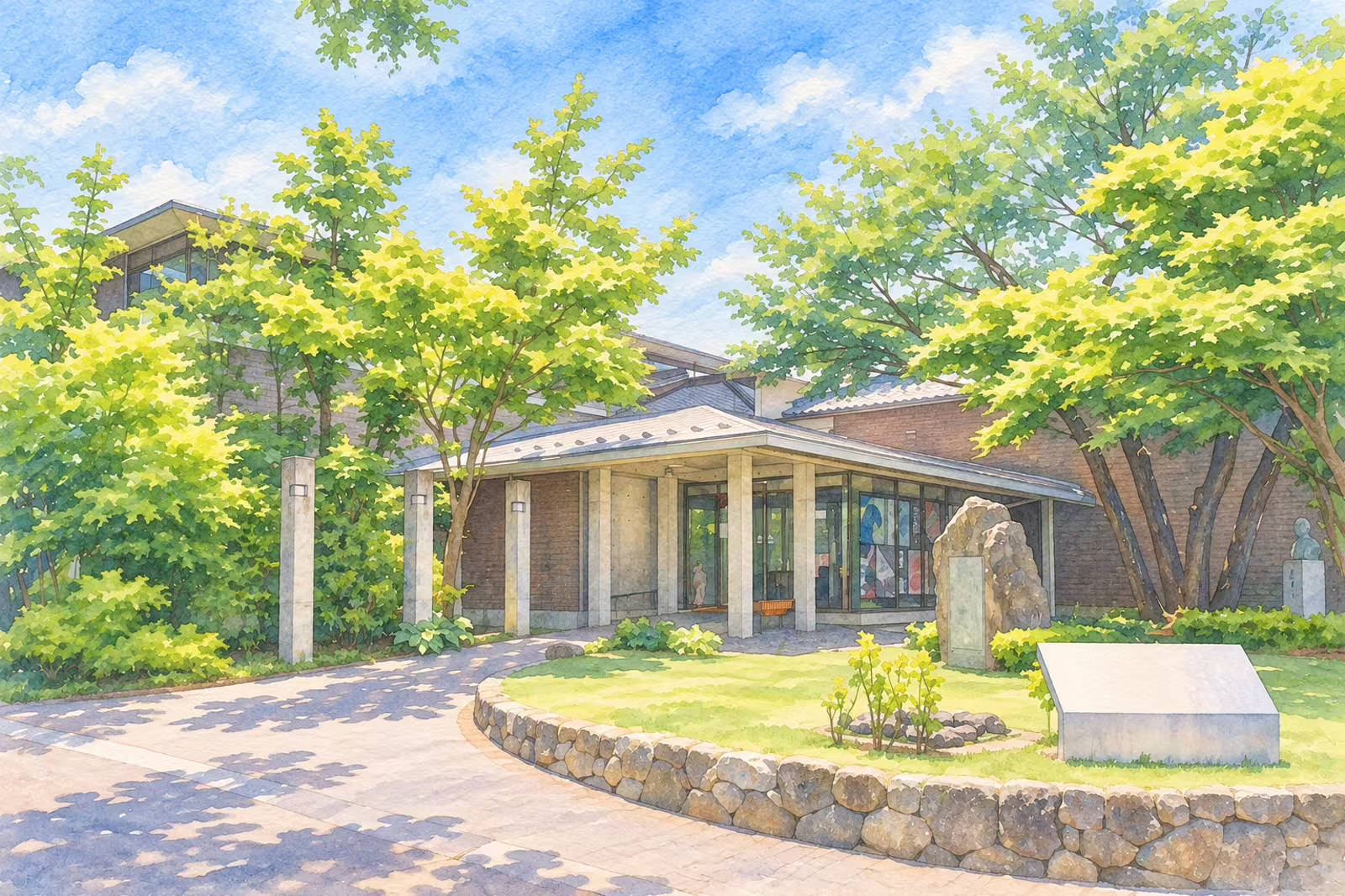
Obuse is a small town in northern Nagano Prefecture that prospered as a market center near the Chikuma River in the late Edo period. The ukiyo-e artist Katsushika Hokusai came here several times in the last decade of his life and left a group of large paintings. Two places in the town, the Hokusai Museum in the center and the temple Ganshō-in at the foot of the eastern hills, are where most of that late work can be seen today.
01Hokusai and Takai Kōzan
Hokusai’s link to Obuse runs through Takai Kōzan (1806–1883), the heir of a wealthy local merchant house. Kōzan had studied in Kyoto and Edo, painted and practiced calligraphy, and became Hokusai’s pupil and patron. Hokusai is generally thought to have first visited in 1842, when he was in his early eighties, and to have returned several times through the late 1840s, working in a studio Kōzan provided. Kōzan’s study, the Yūzenrō, survives as part of the Takai Kōzan Memorial Museum, which also shows his own paintings, including a striking series of ghost and yōkai subjects.
02The Hokusai Museum
The Hokusai Museum opened in 1976 and holds Hokusai’s paintings, prints and illustrated books. Its centerpieces are two festival floats belonging to the town’s Higashimachi and Kamimachi districts. The ceiling panels of the Higashimachi float show a dragon and a phoenix; those of the Kamimachi float show a pair of surging waves, known as the "male wave" and the "female wave." They are usually dated to around 1844 and 1845 respectively. The floats still belong to their neighborhoods and are on long-term deposit at the museum.
03Ganshō-in
Ganshō-in is a temple of the Sōtō Zen school, founded according to temple tradition in the late 15th century. The ceiling of its main hall carries Hokusai’s phoenix, often called the "phoenix glaring in eight directions," completed in 1848. Painted on joined wooden boards and covering an area of about 21 tatami mats, it is said to seem to look at the viewer from any angle. Hokusai died in Edo the following year, aged 88 (90 by traditional count), making this one of the last major works of his career. Unlike the floats, it remains in the building it was made for.
The temple also holds the mausoleum of the warlord Fukushima Masanori, who was stripped of his Hiroshima domain in 1619, sent to a small holding in this part of Shinano, and died here in 1624. The pond behind the temple is said to be where the haiku poet Kobayashi Issa wrote his verse urging a skinny frog not to give up the fight, because "Issa is here."