
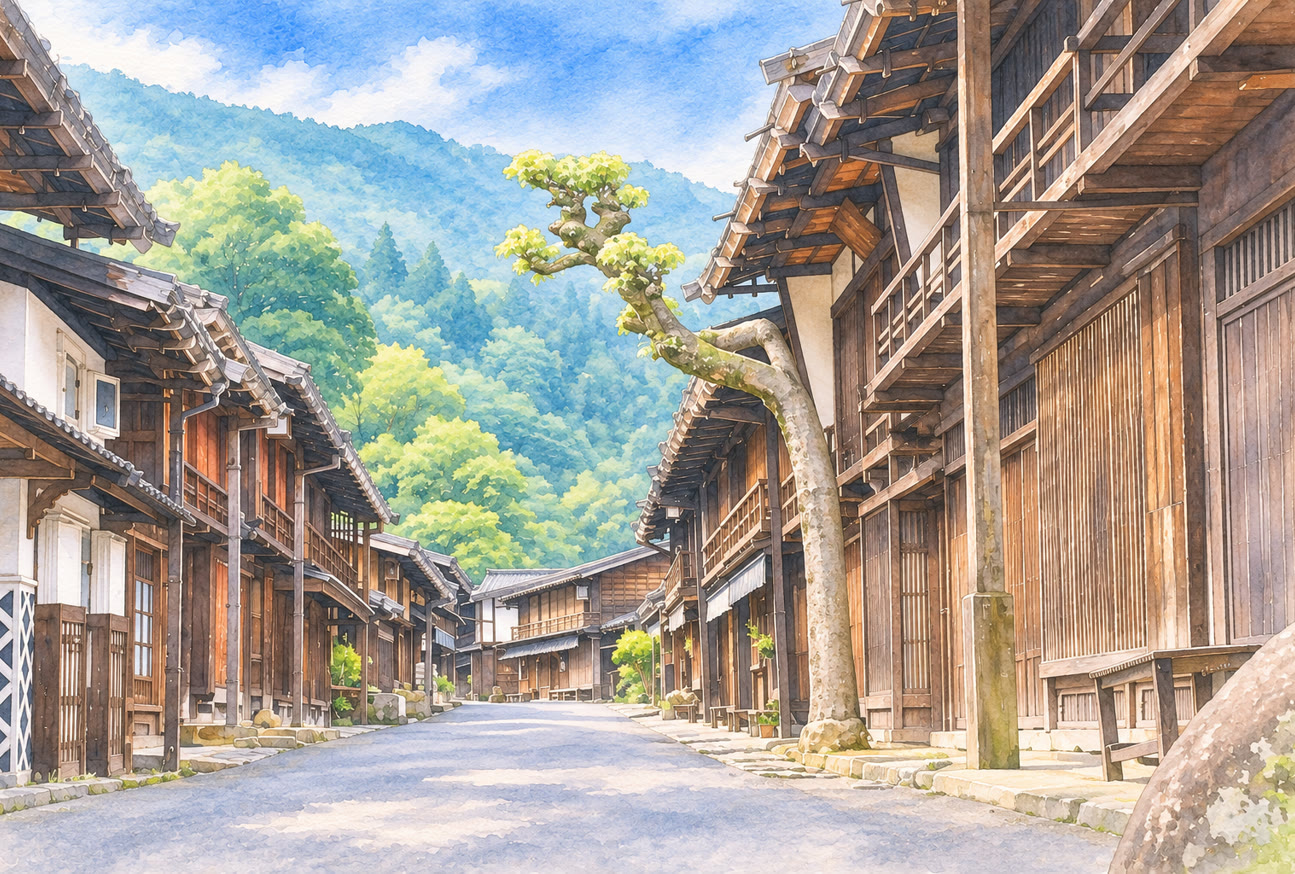
Tsumago and Magome are two neighboring post towns on the Kisoji, the mountain stretch of the old Nakasendō highway between Edo and Kyoto. Tsumago lies in the town of Nagiso in Nagano Prefecture; Magome, about 8 kilometers to the south over the Magome Pass, now belongs to the city of Nakatsugawa in Gifu Prefecture. Tsumago was one of the first places in Japan where residents set out to preserve an entire historic street, and Magome is the birthplace of the novelist Shimazaki Tōson.
01Stations on the Nakasendō
The Nakasendō ran inland through the mountains of central Honshū and had 69 post stations. Eleven of them lay in the Kiso Valley, a narrow forested gorge mostly administered by the Owari domain, a senior branch of the Tokugawa house, which guarded its cypress forests with notorious severity. Counting from Edo, Tsumago was the 42nd station and Magome the 43rd, the last on the Kisoji. Each had a honjin, an official inn for daimyo and court nobles, a secondary waki-honjin, a toiya office that supplied porters and packhorses, and rows of ordinary inns.
In 1861 the enormous procession of Imperial Princess Kazunomiya passed along this road on her way to marry the shogun Tokugawa Iemochi in Edo, and the stations strained to feed and house it. In Magome the Shimazaki family served for generations as honjin keepers and village headmen. Shimazaki Tōson (1872–1943), born there, drew on his father Shimazaki Masaki for the hero of his long novel Yoake mae (Before the Dawn), which opens with the line "The Kiso road lies entirely in the mountains."
02Decline and preservation
The post-station system ended after the Meiji Restoration. When the Chūō Main Line was completed in 1911, the railway, and later the main road, followed the Kiso River on the valley floor, leaving the old hillside towns behind. In 1968 Nagano Prefecture chose Tsumago for a restoration project marking the centenary of Meiji, and residents organized to protect the street. Their 1971 charter adopted the principle of "do not sell, do not rent, do not demolish." In 1976 Tsumago was among the first areas selected as an Important Preservation District for Groups of Traditional Buildings.
Magome burned in large fires in 1895 and 1915, so most of its buildings were rebuilt afterwards. The Tōson Memorial Museum stands on the site of the Shimazaki honjin; its memorial hall was built by local people in 1947. Magome belonged to Nagano Prefecture until 2005, when its village of Yamaguchi merged across the prefectural border into Nakatsugawa.
03What survives
Tsumago keeps a street of late Edo and early Meiji townhouses and a right-angled masugata bend built to slow attackers. The main house of the Okuya waki-honjin (the Hayashi residence), rebuilt in 1877–79 and generally described as making lavish use of cypress, was designated an Important Cultural Property in 2001; the honjin is a 1995 reconstruction based on late Edo-period floor plans. Magome’s sloping stone-paved street is lined with rebuilt inns and shops. The old road between the two towns can still be walked.
Tsumago and Magome
01A road through the mountains
Walk into Tsumago and what strikes you first is not any single building but the continuity of the street: dark wooden lattices, overhanging upper stories, low doorways, one house after another following the slope, with no overhead wires and few signs. Cross the Magome Pass to the south and descend, and you reach Magome, a town built down the flank of a ridge, its stone-paved street dropping steeply between stepped rows of houses. On a clear day Mount Ena stands on the horizon.
Today the two towns lie in different prefectures. Tsumago belongs to the town of Nagiso in Nagano Prefecture; Magome belongs to the city of Nakatsugawa in Gifu Prefecture. The old road between them runs about 8 kilometers over a pass of roughly 800 meters. In the Edo period (1603–1868) they were consecutive stations on the same highway, the Nakasendō, on the stretch through the Kiso Valley known as the Kisoji, or Kiso Road.
The novelist Shimazaki Tōson, who was born in Magome, opened his great historical novel Yoake mae (Before the Dawn) with the sentence "The Kiso road lies entirely in the mountains," and went on to describe a route that clung to cliffs, ran above the gorge of the Kiso River, and threaded deep ravines. That geography made these towns, and later unmade them.
02From ancient road to Tokugawa highway
People crossed the Kiso Valley long before the Tokugawa. In the early eighth century the imperial court opened a road called the Kiso-ji (written with different characters) between the provinces of Mino and Shinano, which is generally regarded as one ancestor of the later route, though its exact line is uncertain. In the late twelfth century the warrior Minamoto no Yoshinaka, raised in these mountains and often called Kiso Yoshinaka, launched his campaign against the Taira from this region. In the medieval centuries the valley was held by the Kiso family, who claimed descent from Yoshinaka; historians have long doubted the claim.
The road became a regulated highway under Tokugawa Ieyasu. After his victory at Sekigahara in 1600, the new regime organized five main routes radiating from Edo and set up post stations along them. Each station was obliged to keep a fixed number of porters and packhorses to relay official travelers, goods and documents to the next station. The Nakasendō left Edo at Nihonbashi, crossed the provinces of Musashi, Kōzuke, Shinano, Mino and Ōmi, joined the coastal Tōkaidō at Kusatsu, and ended in Kyoto. It had 69 stations, most of them fixed in the first years of the seventeenth century.
The Nakasendō was more mountainous than the Tōkaidō, but it avoided the great unbridged rivers of the coast, such as the Ōi, which travelers had to ford or be carried across and which could strand them for days when in flood. For that reason it was favored by noblewomen traveling between Kyoto and Edo. Eleven of its stations lay in the Kiso Valley, from Niekawa in the north to Magome in the south. Counted from Edo, Tsumago was the 42nd station and Magome the 43rd.
03Tsumago Castle
On the hill north of Tsumago are the remains of Tsumago Castle, not a towered fortress but a small medieval mountain stronghold: levelled terraces and cut trenches on a summit commanding the valley road.
According to the usual account, during the Komaki–Nagakute campaign of 1584, when Toyotomi (then Hashiba) Hideyoshi and Tokugawa Ieyasu confronted each other, the lord of the valley, Kiso Yoshimasa, sided with Hideyoshi. Tokugawa troops under Suganuma Sadatoshi, Hoshina Masanao and Suwa Yoritada crossed from the Ina side by the Seinaiji Pass, and the small garrison at Tsumago held out until they withdrew. The defender is usually named as Yamamura Yoshikatsu, a Kiso retainer; the garrison is said to have numbered about 300 against a Tokugawa force put at 7,000. His family later served the Tokugawa as hereditary intendants of the valley, based at Kiso-Fukushima, and the defense of Tsumago became part of their family story. Much of the detail comes from later compilations and may be embellished.
When Hideyoshi moved Ieyasu to the Kantō in 1590, the Kiso family was transferred too, and the valley came under Toyotomi control. In 1600 the Yamamura and other former Kiso retainers went over to the Tokugawa side. Tokugawa Hidetada’s army marched west along the Nakasendō that year and famously arrived late for Sekigahara after being held up by the Sanada at Ueda; its route lay through this valley. With peace, the castle lost its purpose and is generally said to have been abandoned around 1616. Only the terraces and earthworks remain.
04Owari’s forests
Economically, the Kiso Valley mattered less for its stations than for its trees. In 1615 the valley was assigned to the Owari domain, held by one of the three senior branch houses of the Tokugawa, with the Yamamura family managing it on the domain’s behalf. Owari prized the valley’s Japanese cypress (hinoki) and related conifers, which were floated down the Kiso River to supply Nagoya and the construction of castles, temples and shrines.
Heavy logging in the seventeenth century depleted the forests, and Owari tightened its controls. In 1708 hinoki, sawara, asunaro and kōyamaki were designated protected trees that could not be cut without permission, and nezuko was added around 1728; the five species came to be known as the "five trees of Kiso." A popular saying held that the price of a tree was a head. That was an exaggeration, but the rules were real, and villagers were restricted even in the timber they could use for their own houses.
This shaped what the post towns looked like. Ordinary Edo-period houses in Tsumago and Magome were seldom built of fine cypress. After the Meiji Restoration the old forest regime collapsed, and for a time residents had freer access to timber. The Okuya house in Tsumago, rebuilt in 1877–79, is generally described as making lavish use of hinoki, as if to make up for lost time.
05How a post station worked
A post station was part of the shogunate’s transport system, not just a row of inns. Each had a toiya-ba, an office run by station officials who assigned porters and horses to official travelers and passed loads on to the next station. When a station ran short, it called on surrounding villages to supply labor and animals under a levy known as sukegō, a heavy burden on farmers along the road.
At the center stood the honjin, the official inn for daimyo, court nobles and senior shogunal officials. It was usually run by a leading local family on a hereditary basis and had features forbidden in ordinary houses, such as a formal entrance hall and a raised reception room. A secondary inn, the waki-honjin, took overflow or lower-ranking guests. Ordinary travelers stayed at hatago, inns that served meals; the poorest used kichin-yado, where they brought their own rice and paid only for firewood.
In Tsumago the honjin and a toiya were held by a Shimazaki family, and the waki-honjin by the Hayashi family, whose house was called Okuya and who also served as village headmen and toiya. In Magome a branch of the Tsumago Shimazaki held the honjin, the toiya and the headship. Tōson’s mother is recorded as coming from the Tsumago Shimazaki, and one of his elder brothers, Shimazaki Hirosuke, was later adopted into the Tsumago honjin and became its last head.
When a daimyo passed on his alternate-attendance journey (sankin-kōtai) with a retinue of several hundred, the party had to be split among the honjin, waki-honjin and inns, and the changeover of horses and porters could be chaotic. Level ground in the valley was scarce, so the Kiso stations were generally smaller than those on the plains; figures for the number of inns vary between sources.
06The princess’s procession, 1861
The grandest procession ever to pass along the Kiso Road was that of Imperial Princess Kazunomiya in 1861. The younger sister of Emperor Kōmei, she was married to the fourteenth shogun, Tokugawa Iemochi, as part of a policy of reconciling court and shogunate. The Nakasendō was chosen rather than the Tōkaidō chiefly, it seems, to avoid the river crossings and possible disturbances on the coast; a widely repeated story that certain Tōkaidō place names were ill-omened for a bride is probably a later embellishment.
The princess left Kyoto in the tenth month of Bunkyū 1 and reached Edo in the following month. With courtiers, shogunal officials and guards supplied by many domains, the procession is said to have numbered in the tens of thousands, and it took several days to pass a single station. Roads were repaired and buildings refitted in advance, and villages far from the highway were ordered to supply men and horses. For the small Kiso stations it was an enormous expense and an early taste of national politics arriving on their doorstep. Seven years later, in 1868, the new government’s Tōsandō army marched toward Edo along the same road.
07The Shimazaki of Magome and Before the Dawn
Shimazaki Tōson, whose given name was Haruki, was born in 1872 in the Shimazaki honjin at Magome. In 1881 he was sent to Tokyo for schooling, and he never again lived in the village for long. He made his name as a poet with Wakanashū (Collection of Young Herbs) and then turned to fiction, becoming one of the leading writers of Japanese naturalism with Hakai (The Broken Commandment) and Ie (The Family).
His father, Shimazaki Masaki, headed the Magome honjin and was a follower of the Hirata school of nativist learning. He hoped the restoration of imperial rule would bring back an idealised ancient order and was bitterly disappointed by what the new government actually did. The forests were taken into state ownership, and villagers lost their customary rights to timber; the post-station system was abolished, and with it the honjin’s role. In his last years Masaki became mentally ill. He is recorded as having tried to set fire to Eishō-ji, the family temple, and was confined at home, where he died in 1886.
Late in life Tōson turned his father’s story into Before the Dawn, serialised in the magazine Chūō kōron from 1929 to 1935. Its hero, Aoyama Hanzō, keeps the Magome honjin. The novel follows him from the last years of the shogunate into Meiji and views the great events of the age, the princess’s procession, the passage of the Mito rebels known as the Tengu-tō, the advance of the imperial army, through the eyes of a small mountain station, while tracing the collapse of Hanzō’s hopes into madness. Most characters have real models, but it is a novel, and its scenes and dialogue should not be read as a historical record.
Tōson died in August 1943 at Ōiso in Kanagawa Prefecture and, as he had asked, was buried at Jifuku-ji there. In October that year locks of his hair and nail clippings were interred at Eishō-ji in Magome. The Tōson Memorial Museum stands on the site of the honjin; its core, the memorial hall designed by the architect Taniguchi Yoshirō, was built in 1947 by the people of the village, who gave labor and materials. It displays his manuscripts, belongings and material relating to Before the Dawn. Most of the original honjin was lost to fire; a small retirement cottage on the site is thought to be one of the few structures to have survived the 1895 fire.
08Bypassed
The post-station system was abolished in the early 1870s, and the honjin, waki-honjin and toiya lost their official functions. Travelers and goods continued to use the old road for a while, but not for long.
The Chūō Main Line was built in sections in the late Meiji period and completed in 1911. Through the Kiso Valley the tracks followed the river on the valley floor, with stations such as Nagiso and Sakashita well below the hillside towns. The later national highway, Route 19, did the same. Nobody needed to climb the Magome Pass any more, and the traffic that had sustained both towns disappeared.
For more than half a century people moved away and houses decayed. But because neither railway nor highway ran through it, Tsumago kept its street plan and many houses from the late Edo and Meiji periods.
09Tsumago: do not sell, rent or demolish
In the 1960s, as Japan’s economy boomed, historic streets across the country were being torn down. People in Tsumago and Nagiso began to ask whether their decaying street might be worth more preserved than replaced. In 1968, the centenary of the Meiji era, Nagano Prefecture adopted the restoration of Tsumago as a commemorative project. With architectural historians surveying and advising, houses were repaired one by one, later shopfronts were removed, and Edo-period facades were restored.
In 1968 residents formed an association, the Society for Loving Tsumago, and in 1971 adopted a charter built on three principles: do not sell, do not rent, do not demolish. Houses and land were not to be sold to outsiders or leased to outside businesses, and old buildings were not to be pulled down. The charter also controlled signs, wiring and the design of new buildings, which is why the street today has almost no overhead cables or large advertisements. It was unusual at the time and has often been cited as a model for community-led conservation in Japan.
In 1975 an amendment to the Law for the Protection of Cultural Properties created a system of preservation districts for groups of traditional buildings. In 1976 Tsumago was among the first areas selected as an Important Preservation District for Groups of Traditional Buildings. Other Kiso stations, such as Narai, were selected later.
Preservation has not meant freezing the town. People still live in these houses, run shops and guesthouses, and carry out repairs under agreed rules. Tourism brings income, and also the parking, crowds and pressure on daily life familiar to every protected district.
10Magome: fire, rebuilding and a new prefecture
Magome followed a different path. Built tightly on a steep slope, it was devastated by two large fires, in 1895 and 1915; the first destroyed the honjin, and between them they consumed most of the inns. The houses visible today were mostly rebuilt afterwards, and the street was later refurbished in post-town style, with stone paving and features such as a waterwheel. Magome is therefore more a re-creation of a post-town landscape than a surviving ensemble like Tsumago.
Its administrative history is also tangled. In the Edo period it belonged to the Kiso Valley under Owari; after Meiji it was part of Kiso District in Nagano Prefecture. Its daily life, however, was closely tied to Nakatsugawa just across the border in Gifu, and proposals to change prefectures were debated repeatedly after the Second World War. In 2005 the village of Yamaguchi, which included Magome, merged across the prefectural line into Nakatsugawa. Cross-prefecture mergers are rare in postwar Japan, and this one was fiercely contested in Nagano. The southernmost station of the Kiso Road is no longer, administratively, in Kiso.
11Walking from Tsumago to Magome
Many visitors walk the old Nakasendō between the two towns, in one direction or the other.
In Tsumago, look for the masugata in the middle of the street, where the road turns at right angles, said to have been designed to stop attackers charging straight through. Nearby is a reconstructed notice board, the kōsatsu-ba, where official edicts were posted. The Okuya waki-honjin, rebuilt in the early Meiji years, has been a nationally designated Important Cultural Property since 2001; its sunken hearth and the light falling through the lattices are favorites of photographers. The honjin next door was reconstructed in 1995 from late Edo-period floor plans and is shown together with Okuya and a local history museum. The Terashita area below the main street was among the first sections to be restored.
South of Tsumago, the road passes the old houses of Ōtsumago and climbs into the forest on stone paving and through cedar groves. It passes the paired waterfalls Odaki and Medaki, said to appear in Yoshikawa Eiji’s novel Musashi. Higher up, at Ichikokutochi, an old tateba teahouse survives; tateba were rest stops between stations for travelers and packhorses. Beyond the Magome Pass the road descends, crossing the line between Nagano and Gifu.
In Magome, the stone street leads past the Tōson Memorial Museum on the honjin site and a few small museums of post-town life. Near the lower end is a reconstructed notice board, and from a lookout at the top Mount Ena comes into view. Eishō-ji, the Shimazaki family temple that appears repeatedly in Before the Dawn, stands on a lane just off the main street.