
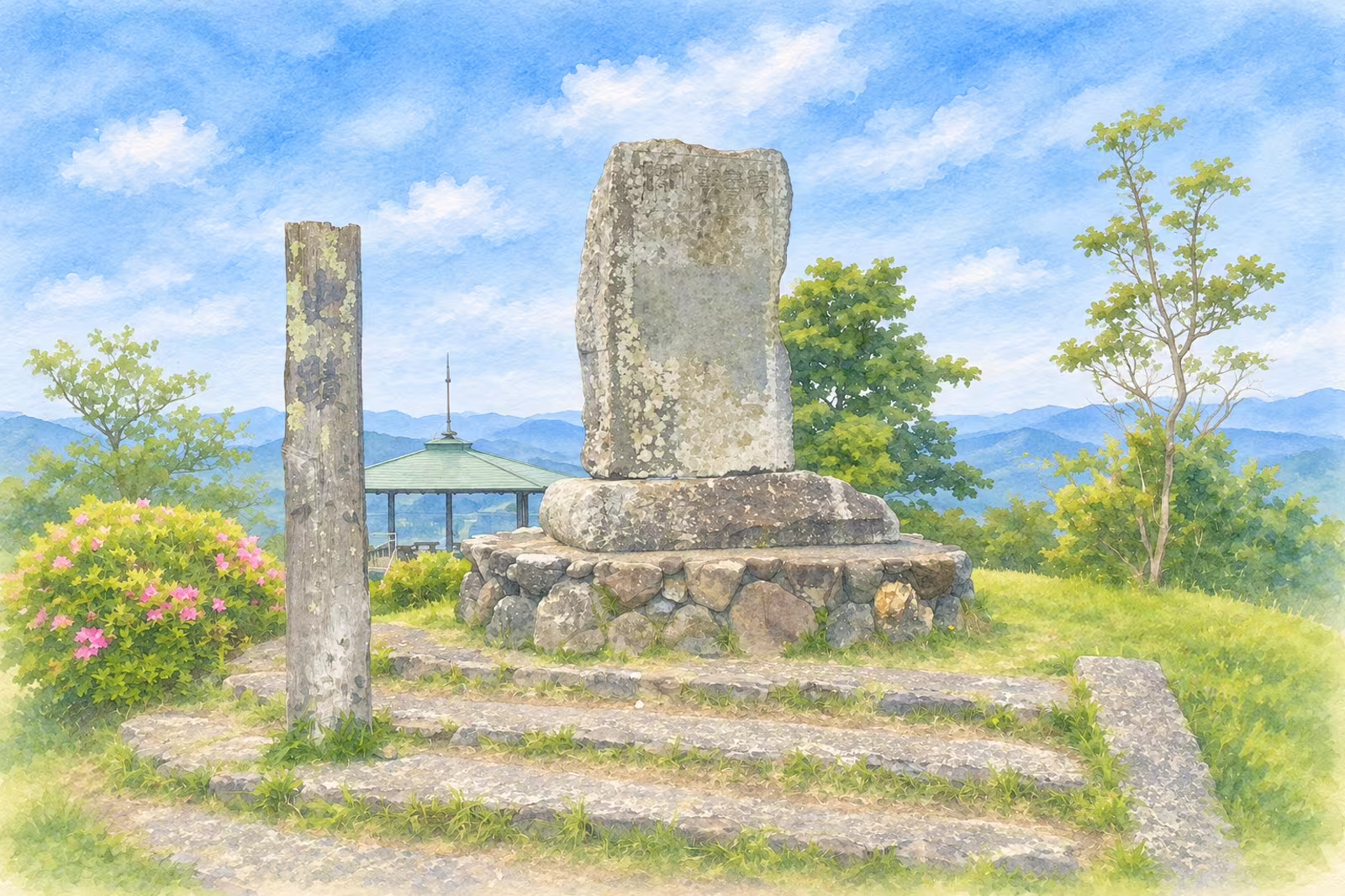
The Shizugatake Battlefield lies in the hills of northern Nagahama, Shiga Prefecture, between the northern shore of Lake Biwa and the smaller Lake Yogo. In 1583 Hashiba Hideyoshi and Shibata Katsuie fought here for control of the Oda house after the death of Oda Nobunaga. Hideyoshi’s victory cleared his path toward the unification of Japan. The battlefield is not a single summit but a chain of field fortifications strung along ridges and lakeshores for more than ten kilometers.
01Stand-off and Battle
After the Honnō-ji Incident of 1582, the senior Oda retainers met at Kiyosu to settle the succession and redistribute territory, and the rivalry between Hideyoshi and Katsuie came into the open. In the spring of 1583 Katsuie marched south from Echizen and dug in around Gyōichiyama and Genbaō Castle (also called Uchinakaoyama Castle). Hideyoshi’s side fortified Shizugatake, Ōiwayama, Iwasakiyama, Tagamiyama and other heights to block the Hokkoku road. The two armies faced each other across the valleys for more than a month.
In the fourth month of 1583 Hideyoshi left the front to deal with Oda Nobutaka in Mino. Katsuie’s nephew Sakuma Morimasa seized the chance and stormed Ōiwayama, where the commander Nakagawa Kiyohide was killed. Hideyoshi hurried back from Ōgaki overnight, reportedly covering more than fifty kilometers in about five hours, a march later known as the "Mino Ōgaeshi." His counterattack the next day drove Morimasa back, Maeda Toshiie withdrew his troops from the field, and the Shibata line collapsed. Katsuie fled to Kitanoshō Castle in Echizen, where he soon took his own life together with his wife Oichi. Morimasa was captured and executed.
The young retainers of Hideyoshi who led the charge became known as the "Seven Spears of Shizugatake," usually listed as Katō Kiyomasa, Fukushima Masanori, Katō Yoshiaki, Wakisaka Yasuharu, Hirano Nagayasu, Kasuya Takenori and Katagiri Katsumoto. The label owes something to later publicity; more than seven men distinguished themselves.
02What Can Be Seen Today
The summit of Shizugatake, about 420 meters high, overlooks both Lake Yogo and Lake Biwa and carries a memorial to the dead and a modern statue of a warrior. Ōiwayama has the grave of Nakagawa Kiyohide, and graves and monuments connected with the fighting stand near Lake Yogo. Earthen ramparts, ditches and levelled enclosures survive on many of the hills; most were short-lived field works, and no buildings remain. At the northern end, the ruins of Genbaō Castle straddle the border between Shiga and Fukui prefectures, with well-preserved enclosures and ramparts, and are designated a National Historic Site. Today the battlefield is divided by roads, railways, forest and farmland, and the level of protection differs from one site to another.