
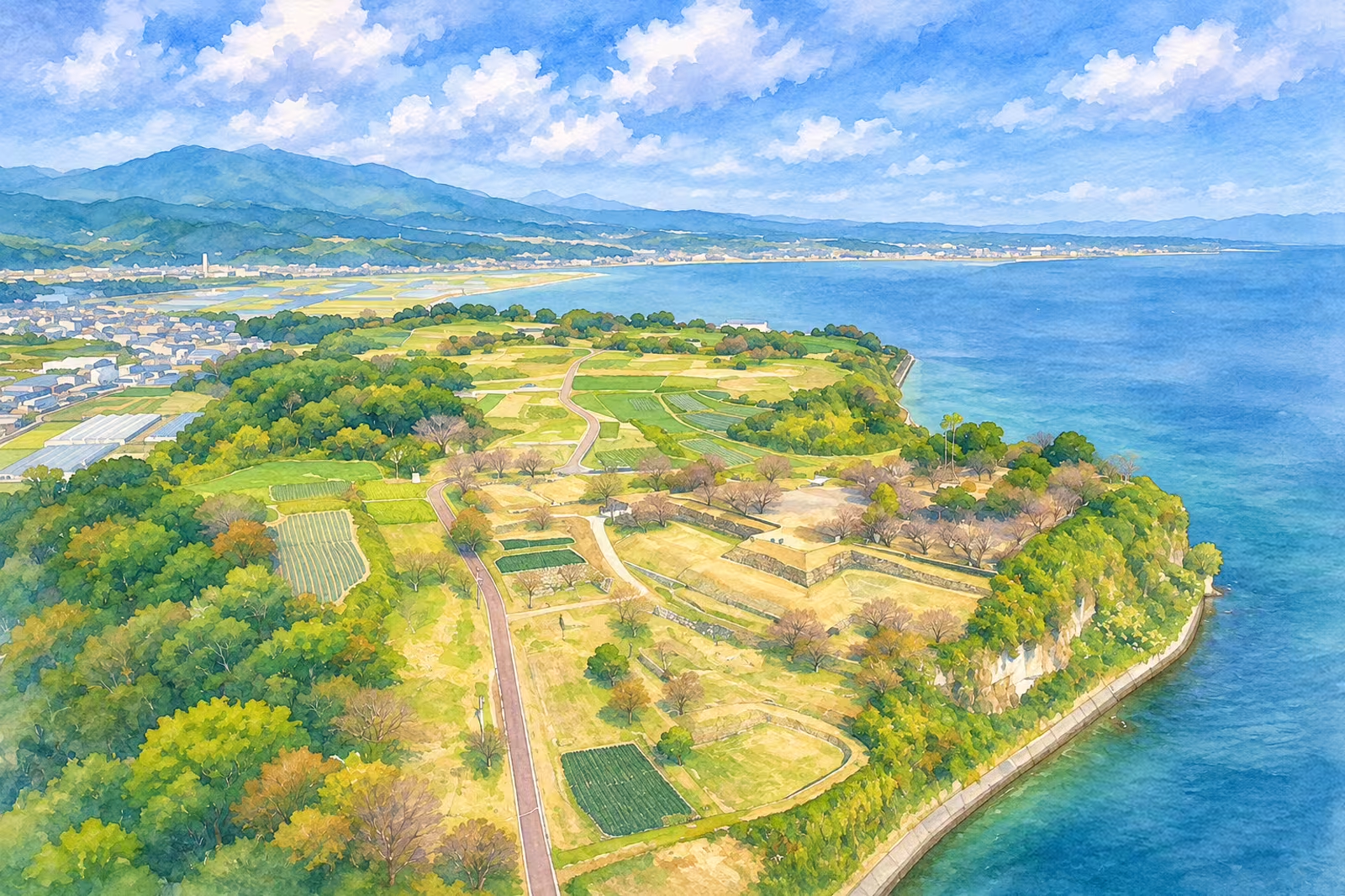
The ruins of Hara Castle lie in Minamishimabara, Nagasaki Prefecture, on a headland at the southern tip of the Shimabara Peninsula that juts into the Ariake Sea. During the Shimabara Rebellion of 1637–1638, tens of thousands of insurgents held out in this abandoned castle, and nearly all of them were killed when shogunal forces stormed it. Above ground there is little left beyond demolished stone walls and open fields, but the soil preserves a large body of material from the siege.
01A castle of the Arima
The local lord Arima Harunobu built Hara Castle in the early 17th century as a branch castle of his main seat, Hinoe Castle. The Arima were Christian daimyo, and the area had many Christians at the time. In 1614 the Arima were transferred to Hyūga; the new lord, Matsukura Shigemasa, built Shimabara Castle instead, and Hara was abandoned.
02The rebels’ last stronghold
Under the Matsukura, taxes were heavy and Christianity was harshly suppressed, and poor harvests made matters worse. In the autumn of 1637 people in Shimabara and in Amakusa across the water rose in revolt. They took the young Amakusa Shirō as their leader and at the end of the year moved together into Hara Castle, repairing its old defenses. Estimates of their numbers vary, generally between about 20,000 and 37,000, and many women and children were among them. Itakura Shigemasa, the first commander sent by the shogunate, was killed in an assault early in 1638. His successor, Matsudaira Nobutsuna, assembled some 120,000 troops from the Kyūshū domains, settled into a long siege and even had a Dutch ship bombard the castle from the sea. At the end of the second month of 1638, with the defenders out of food, the shogunal army launched a general assault. When the castle fell almost everyone inside was killed. The castle was then torn down completely, its stone walls toppled and buried so that it could never be used again.
03What can be seen today
The castle site is a National Historic Site. Excavations since the 1990s around the honmaru have uncovered large quantities of human bones along with crosses, religious medals, rosary beads and other devotional objects, which, together with the toppled walls, form physical evidence of the siege. In 2018 the site was inscribed as a World Heritage Site as a component of the Hidden Christian Sites in the Nagasaki Region, where it is presented as the starting point of the period in which Christians, under the ban, went underground. A statue of Amakusa Shirō and memorials to the dead, all later additions, stand on the site of the honmaru.
Hara Castle Ruins
01A Headland with Nothing Standing
Hara Castle sits at the southern tip of the Shimabara Peninsula in Nagasaki Prefecture, in what is now the town of Minami-Arima in Minamishimabara City. The castle occupied a flat-topped promontory pushing out into the Ariake Sea, a shallow inland sea bounded by the coasts of Nagasaki, Saga, Fukuoka and Kumamoto. Cliffs drop to the water on the seaward side, and on the landward side the approaches were once marsh and paddy. From the top of the inner enclosure you look east across the water toward Kumamoto and south toward the Amakusa Islands.
There is no keep here, no gate, no turret. What you see is grass, farmland, broken lengths of stone wall, a handful of monuments and a statue of a boy. Hara Castle matters not for what was built but for what happened inside it in the winter of 1637–38. Tens of thousands of peasants, fishermen and masterless samurai from Shimabara and Amakusa held the ruined fortress for about three months against an army raised from all of Kyūshū. When it fell, almost everyone inside was killed. The uprising, known as the Shimabara Rebellion (in Japanese also the Shimabara-Amakusa ikki, or league uprising), was the largest internal war of the Edo period and the last large-scale fighting in Japan for more than two centuries.
02The Arima and the Christian Century
The castle was built by the Arima, the warlord family that had ruled this corner of Hizen Province for generations from Hinoe Castle, a short distance to the north. In the second half of the sixteenth century, Portuguese ships and Jesuit missionaries reached northwestern Kyūshū, and the Arima lord Arima Harunobu was baptized in 1580 under the name Protasio. Christianity spread rapidly among his people. The Jesuits founded a seminary at Arima to train Japanese clergy, and several of the boys sent to Rome on the Tenshō embassy of 1582 had studied there.
Hara was a secondary fortress to Hinoe. An older tradition says the Arima first fortified the headland in 1496; the stone castle whose remains you see was built by Harunobu and completed in 1604. It was a modern design for its day, with its inner enclosure ringed by stone walls of a kind only coming into wide use in Japan at the end of the sixteenth century. It was also called Higurashi-jō, usually explained as "the castle you could gaze at until dusk," for the beauty of the setting.
The Arima connection ended abruptly. In 1612 Harunobu was caught up in a bribery scandal, the Okamoto Daihachi affair, and was exiled and ordered to die. That same year the shogunate began banning Christianity in its own territories, extending the ban nationwide in 1614. Harunobu’s son Naozumi renounced the faith and in 1614 was transferred to Nobeoka in Hyūga Province, far to the east. The Christian population stayed behind.
03The Matsukura Regime
The new lord, Matsukura Shigemasa, arrived from Yamato Province in 1616. He built a new seat, Shimabara Castle, farther up the coast, and abandoned both Hinoe and Hara in keeping with the shogunate’s 1615 rule of one castle per domain; Hara went out of use around 1618. Its walls were left standing, a fact that would matter.
Shimabara Castle was far grander than a domain rated at 40,000 koku (a measure of rice yield used to rank domains) could afford, and Shigemasa paid for it, and for a show of loyalty to the shogunate, by squeezing the farmers. In 1630 he even proposed an expedition against Luzon, the base from which missionaries were reaching Japan. His early tolerance of Christians gave way to harsh persecution in the late 1620s; recalcitrant believers were taken up to the volcanic hot springs of Mount Unzen and scalded with boiling water, one of the most remembered images of the period.
Shigemasa died in 1630 and his son Matsukura Katsuie ruled even more harshly. Accounts written after the rebellion describe taxes on houses, windows, hearths and even on births and burials, and a punishment called the "straw-raincoat dance," in which defaulters were wrapped in straw capes that were then set on fire. Some of this may be exaggerated, but the burden was clearly crushing, and a run of bad harvests in the mid-1630s turned it into famine.
Across the water, the Amakusa Islands belonged to Terazawa Katataka, lord of Karatsu. Amakusa had once been part of the domain of the Christian daimyo Konishi Yukinaga, who was executed after the Battle of Sekigahara in 1600. Many of his former retainers had stayed on as farmers. Here too heavy taxation, persecution and hunger fell on the same people.
04Amakusa Shirō
Before the rising, a prophecy circulated in Shimabara and Amakusa. A missionary expelled years earlier was said to have predicted that after twenty-five years a heavenly youth would appear, the skies would burn, withered trees would bloom, and the faith would be restored. People came to believe that the time had arrived.
The youth they pointed to was Masuda Shirō, known to history as Amakusa Shirō, with the formal name Tokisada. His father, Masuda Jinbei, had been a Konishi retainer. Shirō was said to be about sixteen by the Japanese count, with birth years of 1621 and 1623 both suggested, and he was educated, reportedly having studied in Nagasaki. Stories of miracles gathered around him: a dove that laid an egg in his hand, walking on the sea. These were recorded after the fact and are best read as legend.
Most historians think the planning was done by older men, former retainers of the Konishi and Arima, who met in secret on Yushima, a small island in the sea east of the castle that came to be called Dangō-jima, "conference island." Records say it was there that they chose Shirō as their leader, a figure around whom believers could rally. How much he directed the fighting is still debated. To those inside the castle, he was their commander.
05The Rising
The rebellion broke out in late 1637. In the Arima area villagers killed a local intendant, Hayashi Hyōzaemon, who had come to enforce the ban on the faith. Village after village joined. Rebels burned temples and shrines and besieged Shimabara Castle; they burned much of the castle town but could not take the castle itself.
In Amakusa the people rose at almost the same time. They defeated a force from Karatsu at Hondo and laid siege to the Terazawa stronghold of Tomioka Castle, but again failed to take it.
In January 1638 the two groups crossed the water and joined forces inside the abandoned Hara Castle. They repaired the walls, built palisades and huts, and brought in food and ammunition. Estimates of the number inside vary. The traditional figure is about 37,000; the World Heritage materials say twenty-odd thousand. Many were women, children and the elderly, and records say villages defended sections of the walls together. A chapel was put up in the inner enclosure, and over the castle flew a banner painted with a chalice and host flanked by two praying angels. Known as the Amakusa Shirō battle flag, it survives in the Amakusa Christian Museum in Amakusa City and is designated an Important Cultural Property.
06The Death of Itakura Shigemasa
The shogunate first sent Itakura Shigemasa, a minor lord of 15,000 koku from Mikawa, to command the armies of the Kyūshū domains. His low rank meant that the great Kyūshū lords did not readily take his orders, and the early assaults were poorly coordinated and failed.
When Edo decided to send the senior councilor Matsudaira Nobutsuna to take over, Itakura apparently resolved to win before his replacement arrived. On New Year’s Day of the Japanese calendar, February 14, 1638, he ordered an all-out assault and was shot dead leading it. Thousands of his troops were killed or wounded.
07Nobutsuna’s Siege
Matsudaira Nobutsuna, nicknamed "Chie Izu," the wise lord of Izu, changed tactics. Rather than storm the walls, he surrounded the castle with trenches, earthworks and siege towers, cut it off completely, and waited for hunger to do the work. The besieging army numbered more than 120,000, drawn from almost every domain in Kyūshū, including the Hosokawa, Kuroda and Nabeshima.
He also asked the Dutch trading post at Hirado for help. The Dutch chief, Nicolaes Couckebacker, brought the ship De Ryp and bombarded the castle from the sea for about two weeks. The bombardment did little damage, and some on the shogunate side thought it shameful to call on foreigners against Japanese subjects, so it was halted. For the Dutch, it was a chance to show that, unlike the Portuguese, they could be trusted.
The two sides exchanged messages tied to arrows. Those inside insisted they had risen for their faith and complained of misrule; the besiegers urged surrender and promised that those who were not believers could leave. By late March food inside was nearly gone. According to the records, Nobutsuna had the stomachs of dead defenders opened and found only seaweed and leaves.
08The Fall
On April 11, 1638, the Nabeshima troops attacked ahead of schedule, and the other armies followed, so that the general assault began a day early. The starving defenders fought back with stones, timber and even cooking pots. On April 12 the inner enclosure fell. Amakusa Shirō was killed; his head is generally said to have been taken by Jin Sazaemon, a retainer of the Hosokawa of Kumamoto, and it was displayed in Nagasaki.
Nearly everyone inside was killed, including women and children. The only widely known survivor was Yamada Emonsaku, a painter who had been secretly negotiating with the besiegers and had been imprisoned by the rebels when the plot was discovered. His later account is an important source on life inside the castle. Shogunal losses were also heavy: one estimate puts them at more than 2,000 dead and over 10,000 wounded.
The shogunate then ordered the castle destroyed so that it could never be used again. Its walls were pulled down and the ruins, together with the bodies of the dead, were buried.
09Aftermath: Closing the Country
The reckoning was severe. Matsukura Katsuie was held responsible for provoking the uprising; his domain was confiscated and he was beheaded in Edo, almost the only daimyo in the Edo period to be executed rather than permitted ritual suicide. Terazawa Katataka lost Amakusa and later took his own life, and his house came to an end.
The rebellion hardened the shogunate’s fear of Christianity. In 1639 Portuguese ships were banned from Japan, and in 1641 the Dutch were moved from Hirado to the small artificial island of Dejima in Nagasaki harbor. The system later called sakoku, the "closed country," was now essentially in place. In 1644 the last missionary in Japan was martyred, and from then on the remaining believers had to keep the faith on their own. Every household had to register with a Buddhist temple, and annual inspections, including fumie, in which people were made to step on images of Christ or Mary, were enforced.
The southern Shimabara Peninsula was left nearly empty. The shogunate resettled it with migrants from other domains in Kyūshū and beyond. Amakusa became shogunal territory under the intendant Suzuki Shigenari, whose brother, the Zen monk Suzuki Shōsan, built temples and preached Buddhism there; Shigenari later petitioned for lower taxes on the islands.
Christianity did not vanish. In remote villages of Sotome, the Gotō Islands, Hirado and Sakitsu in Amakusa, communities lived outwardly as Buddhists and Shinto worshippers while secretly passing down prayers and rites. These were the Senpuku Kirishitan, the hidden Christians. They kept their faith without priests for more than two hundred years, until 1865, when a group of them revealed themselves to a French priest at the newly built Ōura Cathedral in Nagasaki.
10Excavation and World Heritage
Hara Castle was designated a National Historic Site in 1938. For decades it was mostly farmland. Systematic excavations from the 1990s uncovered the toppled and buried walls, the pits of half-sunken huts the defenders lived in, large quantities of human bones, and religious objects including crosses and medals, some of the crosses homemade from the metal used for bullets. Beneath the wrecked walls at the main gate of the inner enclosure lay the bones of women and children as well as men, evidence that farmers joined the rising as whole families. The digs confirmed what the documents said about the destruction and burial, and made the site an archaeological witness to the massacre.
On June 30, 2018, the "Hidden Christian Sites in the Nagasaki Region" were inscribed on the UNESCO World Heritage List as a group of twelve component parts. Hara Castle is the first in the series. In the story the listing tells, it marks the beginning, explaining why believers went into hiding: after the rebellion the shogunate saw Christianity as a threat, the ban became total, and believers went underground. The other components include villages in Sotome, Sakitsu in Amakusa, communities and churches in the Gotō and Hirado areas, and Ōura Cathedral in Nagasaki.
11Walking the Site
The main entrance, the Ōte-guchi, was paved with small stones, and bullets and bones have been found there. Walking south you pass the sites of the third and second enclosures, now largely fields and grass. In the third enclosure stands a memorial to Itakura Shigemasa, carved in 1681 but, lacking shogunal permission, only set up here in 1797. The second enclosure was the largest in the castle, and its open ground gives some sense of where thousands of people crowded into makeshift huts. The high spur jutting west from it faced the shogunal lines below and was where the final assault broke in.
The inner enclosure was reached through three gates in turn. At the second, the Uzumi-mon, the ruins have been laid out to show the three stages of demolition: first the big facing stones were tipped over, then the rubble packing behind them was pulled out, and finally everything was buried with the surrounding earth. On the north side a stretch of wall is displayed just as the demolition left it.
Inside the inner enclosure stands a statue of Amakusa Shirō in prayer by the sculptor Kitamura Seibō, a native of this area. Beside it is a gravestone for Shirō that was found built into a farmhouse wall in nearby Nishi-Arie and moved here. The Honekami Jizō, a stone memorial to the Buddhist bodhisattva Jizō, was raised in 1766, about 130 years after the siege, by a local priest and village leaders who gathered the bones still lying on the site and gave them rites without distinguishing friend from foe. From the enclosure the view runs from east to south across the Ariake Sea to the Amakusa Islands, with Yushima offshore.
The Arima Christian Heritage Museum near the site displays devotional objects from the excavations and replicas of the bones as they were found, and the ruins of Hinoe Castle, the Arima family’s main seat in the Christian period, lie a short drive to the north. Standing on the quiet grass, it is hard to picture the crowds who once filled this ground, and harder still to remember that many of them are still beneath your feet.