
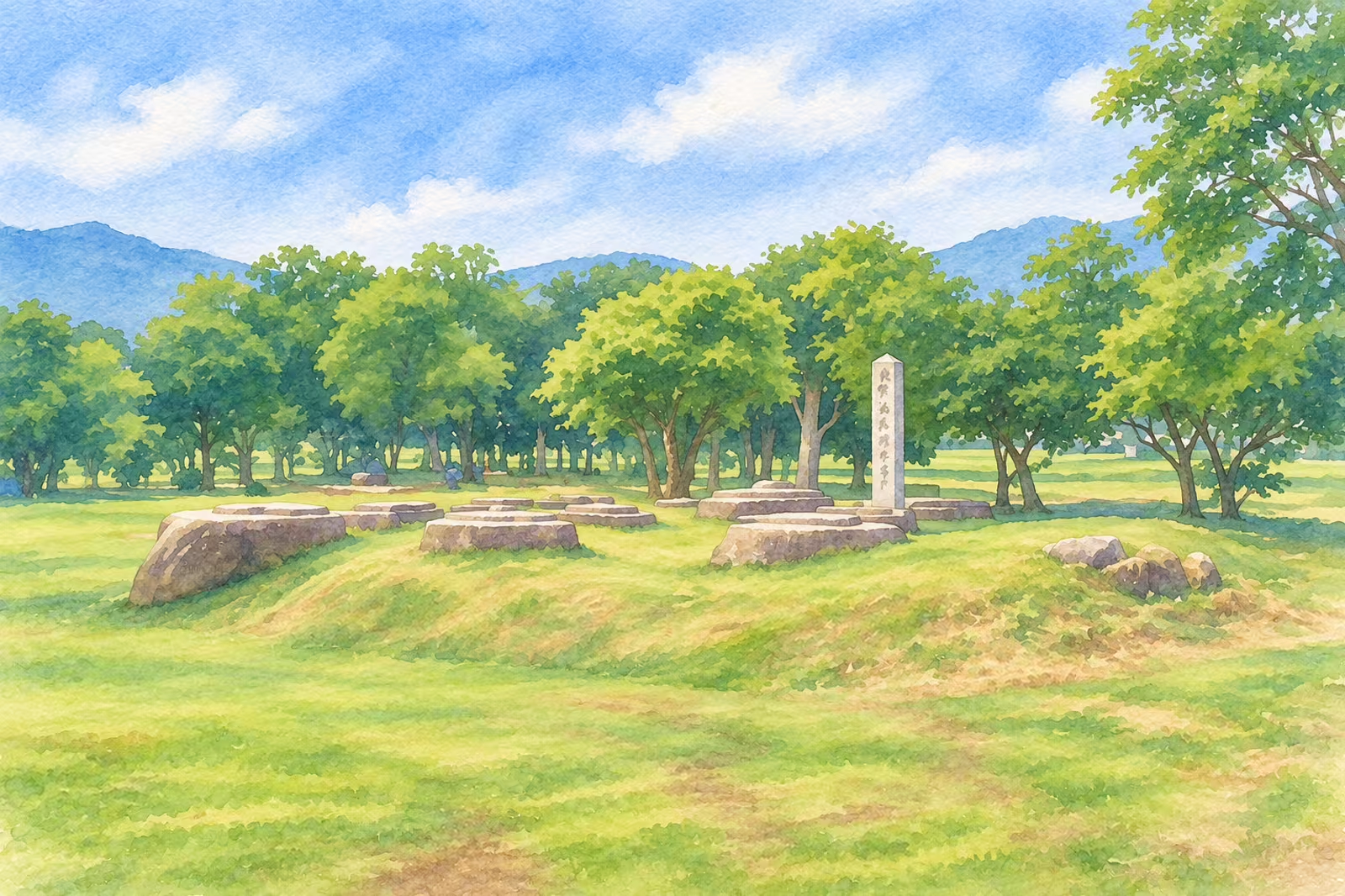
Between 740 and 745, the court of Emperor Shōmu left Heijō-kyō and moved its capital first to Kuni, then to Naniwa and Shigaraki, before returning to Heijō-kyō. The three palace sites now lie in Kizugawa (Kyoto Prefecture), Ōsaka, and Kōka (Shiga Prefecture), and each is a national Historic Site. Seen together, they show how unsettled politics were in the middle of the Nara period, and how much a change of capital cost.
01Three moves in five years
In 740 Fujiwara no Hirotsugu rose in revolt in Kyūshū. Before the rising was put down, Shōmu left Heijō-kyō, traveled through Ise, Mino, and Ōmi, and by the end of the year had begun building a new capital at Kuni in Yamashiro Province. The Minister of the Right, Tachibana no Moroe, is generally thought to have encouraged the move; he had a villa at Ide, close to Kuni. The 741 edict founding provincial temples (kokubunji) and the 743 law allowing permanent private ownership of newly cleared land were both issued at Kuni.
From 742 the court also built a detached palace at Shigaraki in Ōmi. In 743 Shōmu vowed at Shigaraki to make a colossal image of the Buddha Vairocana, and work at Kuni stopped soon afterwards. In 744 Naniwa was declared the capital, although the emperor himself spent much of his time at Shigaraki. Early in 745 Shigaraki was called the new capital, but a series of forest fires and earthquakes followed, and in the fifth month of that year the court went back to Heijō-kyō. The Buddha project moved to Nara as well and became the Great Buddha of Tōdai-ji.
02What can be seen today
At Kuni the earthen platform and foundation stones of the Great Audience Hall (daigokuden) survive. In 746 the hall was given to the Yamashiro provincial temple and became its main hall; the base of a seven-story pagoda stands nearby, so the palace site and the temple site overlap.
At Shigaraki the palace was long placed at Dairino, but excavation showed that the remains there belong to a temple, generally identified as Kōka-ji, linked to the Buddha project. The palace center has been located at the Miyamachi site to the north, most of which is still under rice fields.
The Naniwa palace site lies in a park south of Ōsaka Castle. Two palaces are stacked there: an earlier one from the reign of Emperor Kōtoku in the mid-7th century, and a later one begun in 726 and used when the capital moved in 744. The platform of the later Great Audience Hall has been reconstructed in the park, while the remains of the earlier palace are protected underground.