
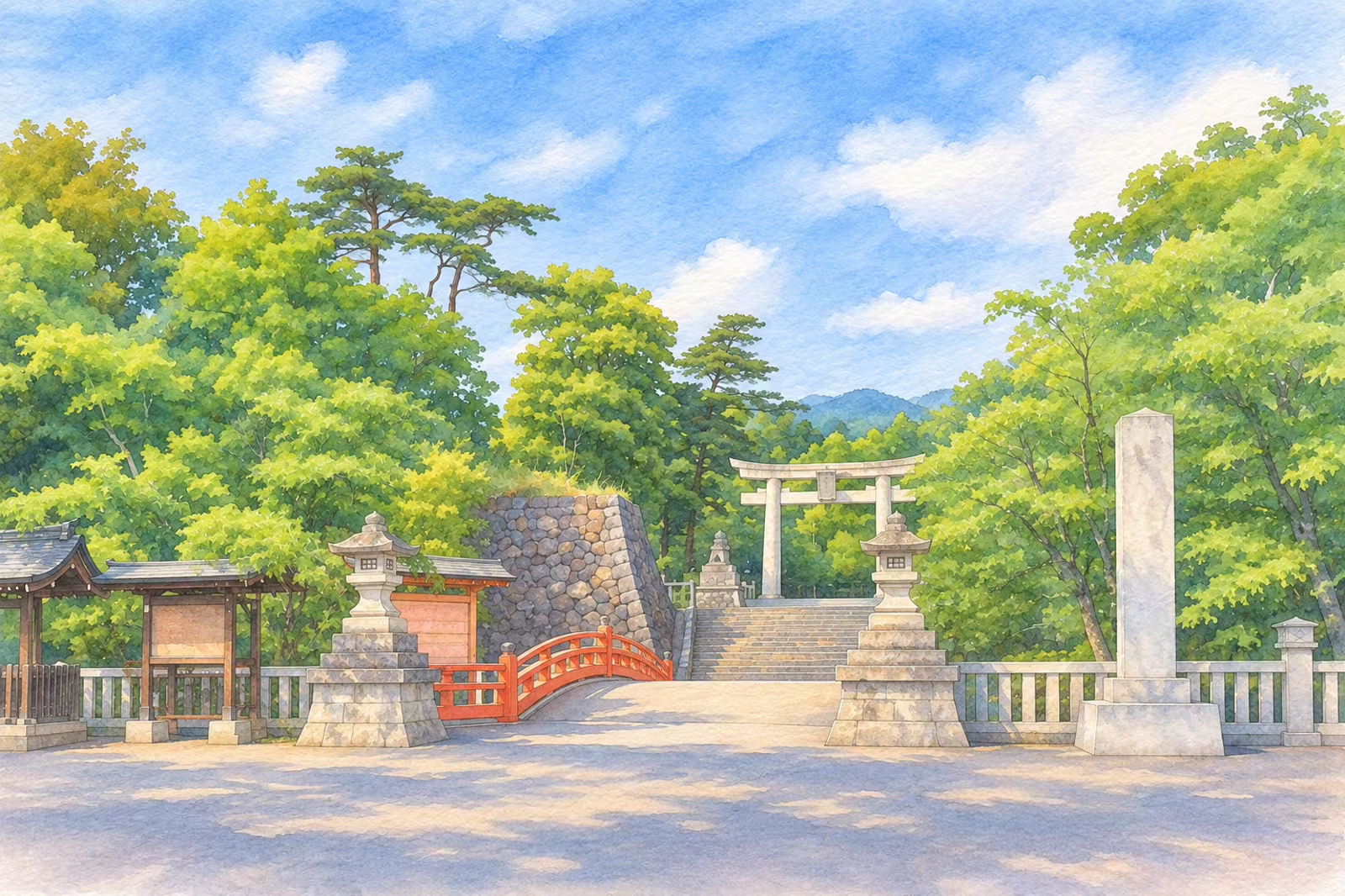
These sites trace the rise and fall of the Takeda of Kai and are spread across three cities in Yamanashi Prefecture: the Takeda residence at Tsutsujigasaki in Kōfu, with the mountain fortress of Yōgaisan behind it; Shinpu Castle in Nirasaki; and Tano in Kōshū, where Takeda Katsuyori died, together with the temple of Keitoku-in. They lie some distance apart and correspond to the seat of Takeda rule, the clan’s last new stronghold, and the place where it ended.
01Tsutsujigasaki and Yōgaisan
In 1519 Takeda Nobutora moved his residence from the Isawa area to Tsutsujigasaki and settled his retainers around it, which marked the beginning of the castle town of Kōfu. The residence was a square compound enclosed by earthen ramparts and a water-filled moat, with no tall keep. On the steep mountain to the north he built Yōgaisan Castle as a refuge in times of danger, and Takeda Shingen is generally said to have been born there in 1521. Shingen and then Katsuyori also ruled from Tsutsujigasaki, which remained the Takeda seat for about 60 years in all.
02Shinpu Castle and the end of the Takeda
After the defeat at Nagashino in 1575, the Takeda position slowly weakened. In 1581 Katsuyori began Shinpu Castle on the Shichiri-iwa plateau in Nirasaki and moved there from Tsutsujigasaki at the end of that year. In the second month of 1582 Kiso Yoshimasa defected to the Oda, and armies under Oda Nobutada, Tokugawa Ieyasu and others invaded Takeda territory along several routes. Castle after castle surrendered; only Nishina Morinobu at Takatō fought to the end. Early in the third month Katsuyori set fire to the unfinished Shinpu Castle and fled. Oyamada Nobushige, with whom he had hoped to take refuge, turned him away, and the party was pursued to Tano at the foot of Tenmokuzan. There, in the third month of 1582, Katsuyori, his heir Nobukatsu, his wife and others took their own lives, and the Takeda house came to an end.
03What remains today
The Takeda residence site is a National Historic Site, and its moats, ramparts and the layout of its enclosures are well preserved. Takeda Shrine, dedicated to Shingen, was founded in the main enclosure in 1919, and its buildings are all modern. The stone walls and keep base on the site are generally thought to be alterations by the lords who governed Kai after the Takeda fell. Yōgaisan retains earthworks and dry moats but has no reconstructed buildings. Shinpu Castle is also a National Historic Site, with large ramparts, ditches and projecting defenses preserved in woodland, and excavation has located gate remains. Keitoku-in at Tano was founded by Ieyasu to pray for Katsuyori’s family, and the graves of Katsuyori, his son and his wife stand in its grounds.