
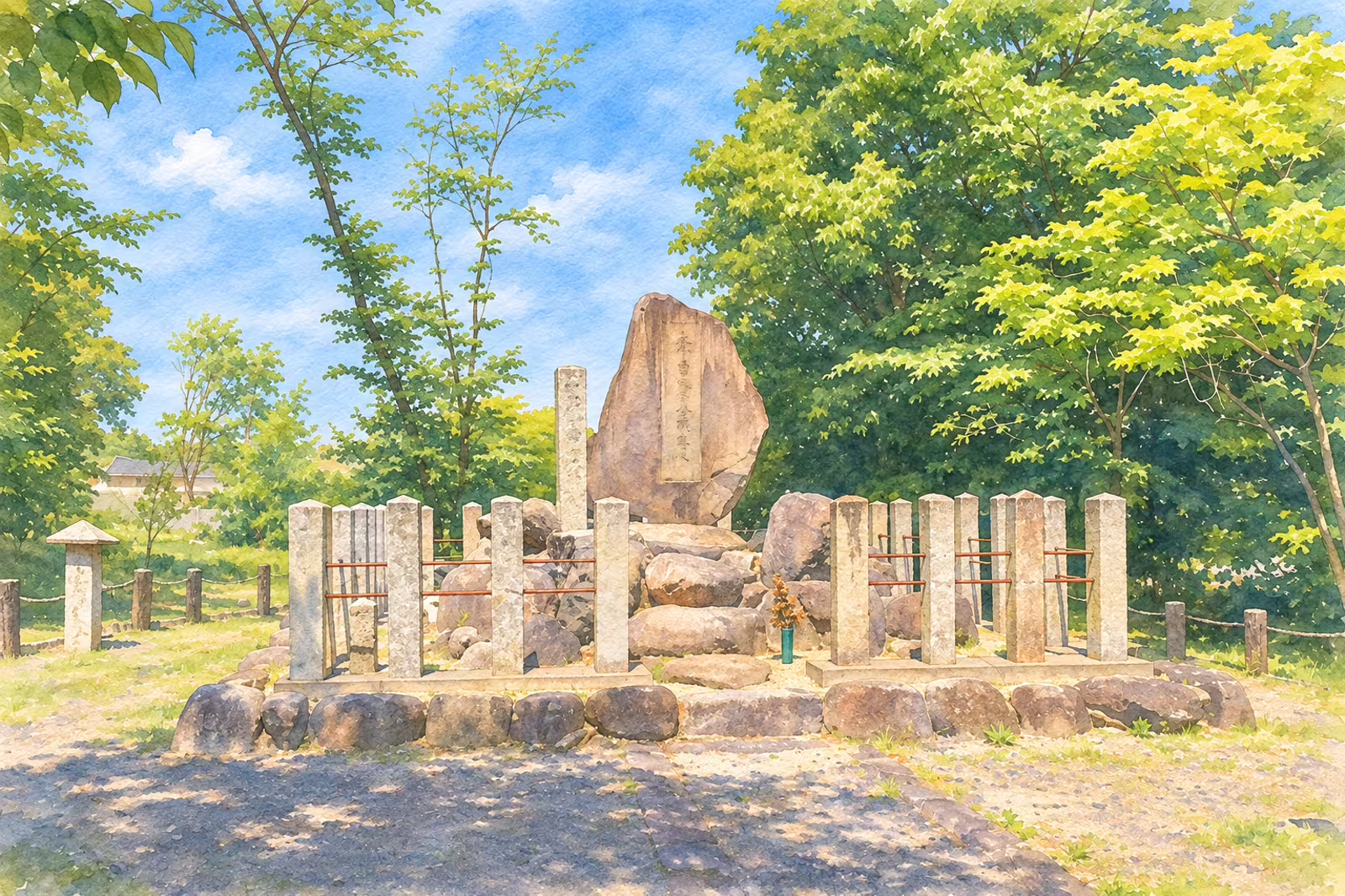
The Komaki–Nagakute Battlefield comprises the two main sites of the 1584 Komaki–Nagakute campaign, in the cities of Komaki and Nagakute in Aichi Prefecture. That year Hashiba Hideyoshi fought Tokugawa Ieyasu and Oda Nobukatsu for control of the order Oda Nobunaga had left behind, the only time Hideyoshi and Ieyasu faced each other in open war. Komaki-yama was the command post for a long standoff; Nagakute was the scene of the decisive field battle.
01From Nobunaga’s castle to Ieyasu’s fortress
Komaki-yama is a small isolated hill on the Nōbi Plain. In 1563 Oda Nobunaga moved here from Kiyosu, built a castle on the summit, and laid out a castle town below. After conquering Mino in 1567 he moved to Gifu, and the castle was abandoned. Recent excavations have confirmed that the hill already carried stone walls in Nobunaga’s time.
In the third month of 1584 Ieyasu seized Komaki-yama first, adding earthen ramparts and ditches to the old castle and building a ring of outlying forts. Hideyoshi took up position to the north around Gakuden. Both sides dug in, neither was willing to attack, and the campaign settled into a stalemate.
02The Battle of Nagakute
To break the deadlock, Hideyoshi’s side sent a force under Ikeda Tsuneoki and Mori Nagayoshi on a wide march south, aiming to strike Ieyasu’s home province of Mikawa. Ieyasu learned of the move and left Komaki-yama in pursuit. In the fourth month of 1584 he first routed the column of Hashiba Hidetsugu at Hakusanbayashi, then engaged the Ikeda and Mori forces around Nagakute. Ikeda Tsuneoki, his son Motosuke, and Mori Nagayoshi were all killed.
Ieyasu won on the battlefield, but Hideyoshi had the larger army and pressed his advantage through diplomacy. In the eleventh month Nobukatsu made a separate peace with Hideyoshi, leaving Ieyasu without a cause to fight for. Ieyasu then sent his second son, Ogimaru, to Hideyoshi as an adopted son, and in 1586 he traveled to the capital and submitted to Hideyoshi.
03What remains today
Komaki-yama is a designated National Historic Site. Earthen ramparts, ditches, and excavated and restored stone walls can be seen on the hill. A modern building in the style of a castle keep stands on the summit and serves as a history museum, and a separate facility at the foot of the hill presents the excavation results. The Nagakute battlefield is also a National Historic Site. The area is now largely residential, but it preserves the hills of Irokaneyama and Mihatayama and later memorial mounds and markers, including Shōnyū-zuka for Ikeda Tsuneoki, Shōkurō-zuka for Ikeda Motosuke, and Musashi-zuka for Mori Nagayoshi. The core of the battlefield has been laid out as a park.