
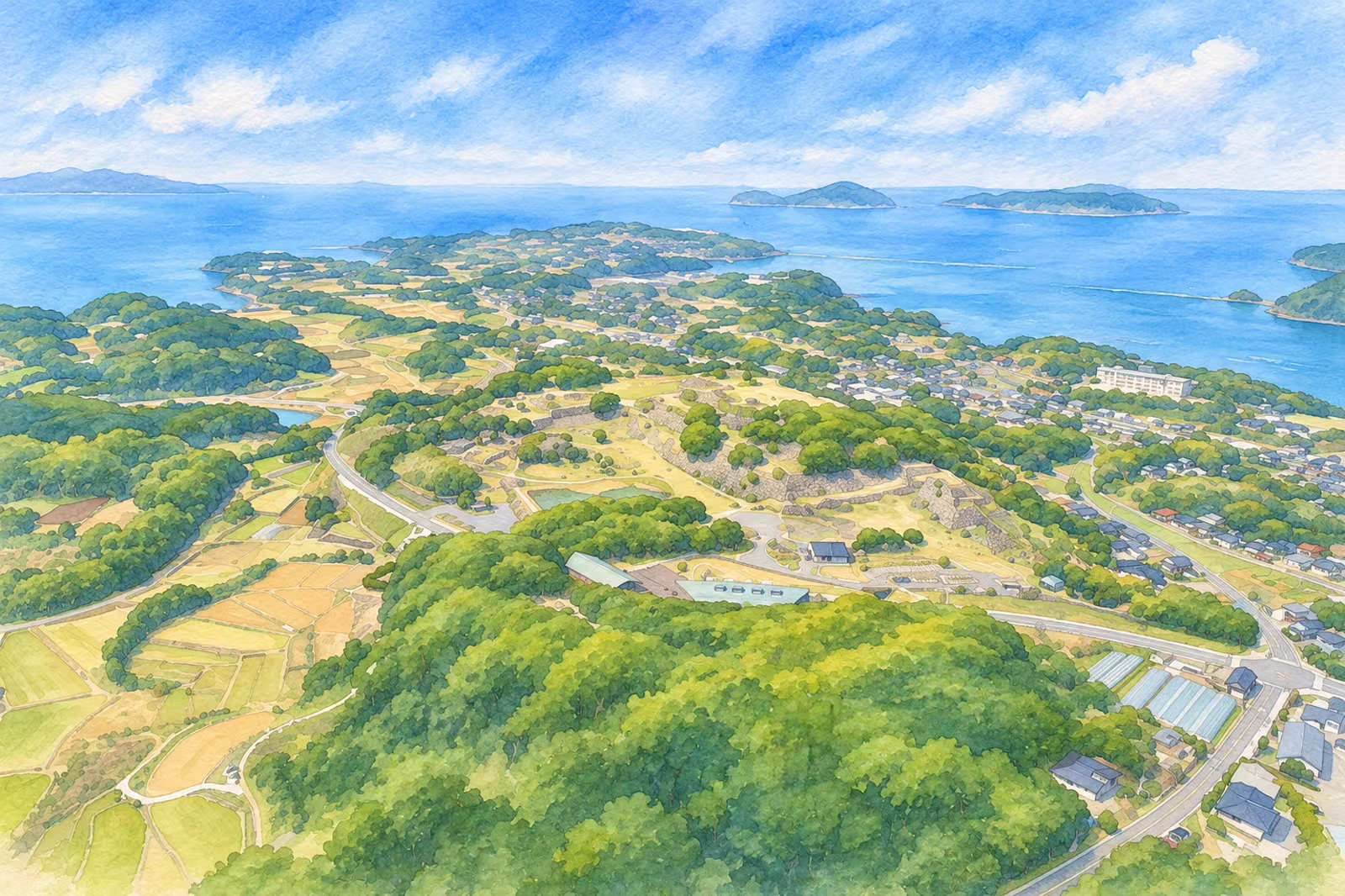
The ruins of Hizen Nagoya Castle stand at the northern tip of the Higashi-Matsuura Peninsula in Chinzei, Karatsu City, Saga Prefecture, looking out over the Genkai Sea. This was Toyotomi Hideyoshi’s headquarters for his invasions of Korea in the 1590s (known in Japan as the Bunroku and Keichō campaigns, and in Korea as the Imjin War). Together with the camps of the daimyo around it, the site shows how a war that brought immense suffering to the Korean peninsula was organized on the Japanese side. The name has nothing to do with the city of Nagoya in Aichi Prefecture.
01Building the Castle and Launching the War
Hideyoshi ordered the castle built in 1591, assigning the work to the daimyo of Kyūshū, and it is said to have been largely finished within a few months. It covered about 17 hectares and had a five-story keep; at the time only Ōsaka Castle was larger. The layout is generally credited to Kuroda Yoshitaka (Kanbei). Within roughly 3 kilometers, daimyo from all over Japan built their own camps; more than 130 have been identified. With merchants and craftsmen added, the population is said to have passed 100,000 at its peak.
From 1592, invasion forces sailed from here by way of Iki and Tsushima to Korea. Hideyoshi himself stayed at the castle for long periods in 1592 and 1593. He received Ming envoys here and held tea gatherings and Noh performances; according to tradition, his famous golden tea room was brought here as well. A second invasion followed in 1597. Hideyoshi died the next year, the armies withdrew, and Nagoya lost its purpose.
02The Site Today
In the early Edo period the castle was deliberately dismantled and many of its stone walls were pushed down. One theory links this to the aftermath of the Shimabara Rebellion of 1637, as a way to keep abandoned castles from being used. Some of its buildings are said to have been moved to Karatsu Castle. What survives are the keep base, the stone walls of the main and outer enclosures, and the excavated foundation stones of the palace and the remains of a tea room. No buildings remain standing. Many daimyo camp sites lie scattered across the surrounding fields and hills.
In 1955 the castle and its camps were designated together as a Special Historic Site. The Saga Prefectural Nagoya Castle Museum, which opened next to the ruins in 1993, covers the war and the wider history of exchange between Japan and the Korean peninsula.