
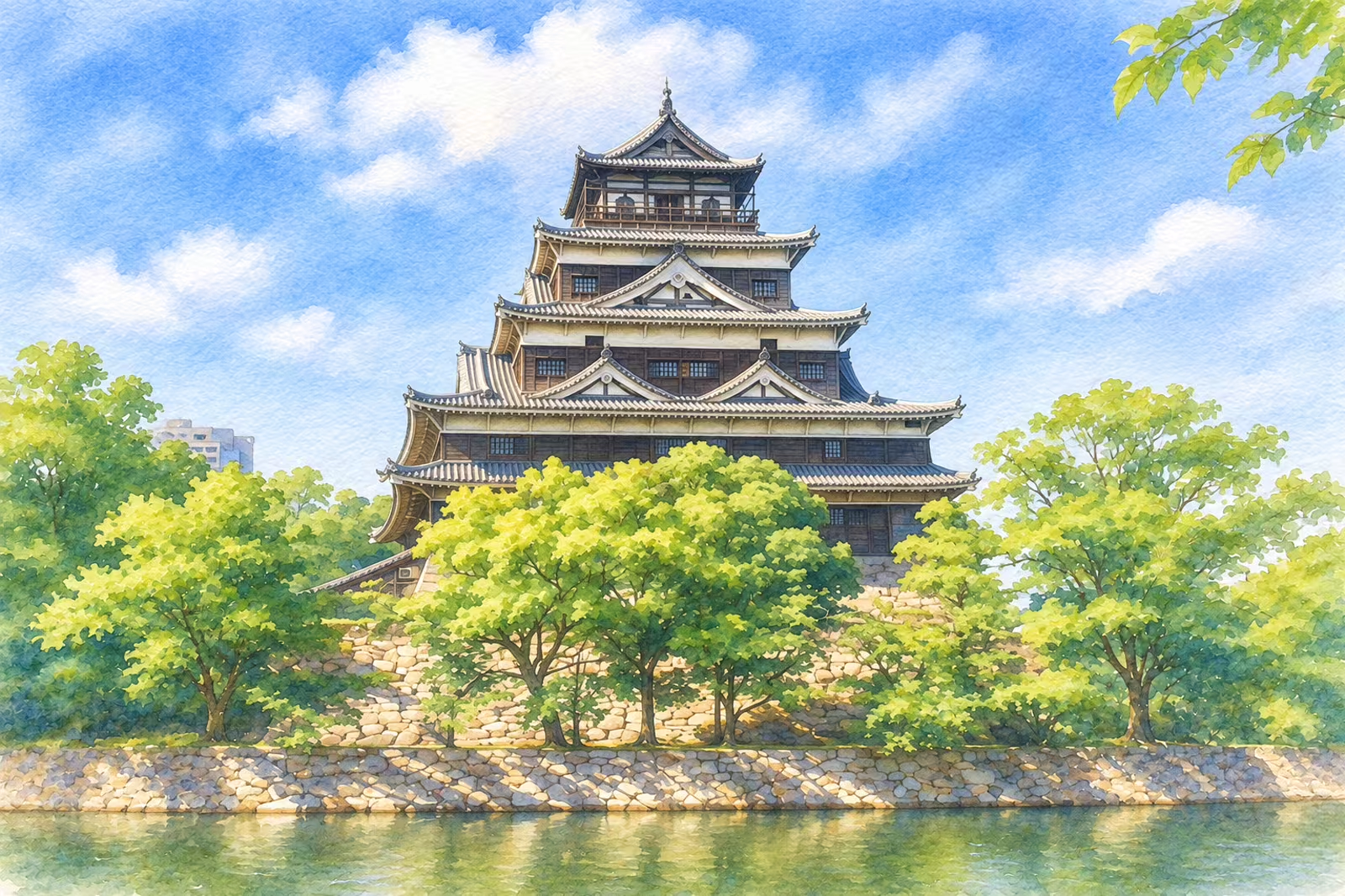
Hiroshima Castle stands in the center of Hiroshima, in Hiroshima Prefecture. Mōri Terumoto built it in the late 16th century as a flatland castle on the delta of the Ōta River, and the city of Hiroshima grew up around it. After the Meiji Restoration the grounds became an army base, and during the First Sino-Japanese War the Imperial General Headquarters was set up in the honmaru (inner bailey), with Emperor Meiji in residence for about seven months. The atomic bombing of 1945 destroyed every building standing in the castle. The keep and the ninomaru buildings seen today are postwar reconstructions.
01The Castle and the Edo Period
Mōri Terumoto, who controlled most of the Chūgoku region, began building on the delta in 1589 and moved in by 1591. The name Hiroshima is generally thought to date from this time. After the Battle of Sekigahara in 1600 the Mōri lost much of their territory and moved to Hagi, and Fukushima Masanori took over Hiroshima. In 1619 Fukushima was removed for repairing the castle without permission from the shogunate. Asano Nagaakira replaced him, and the Asano family governed the Hiroshima domain until the early Meiji years. The centerpiece was a five-story keep linked by corridors to two smaller towers. In 1931 the keep was designated a National Treasure.
02Army Town and Imperial Headquarters
After the domains were abolished, army units occupied the castle, and from 1888 it housed the headquarters of the 5th Division. When war with Qing China broke out in 1894, Hiroshima had a rail connection and the port of Ujina for shipping troops overseas. In September the Imperial General Headquarters moved from Tokyo to Hiroshima and took over the division’s building in the honmaru. Emperor Meiji arrived in mid-September and stayed until the following April. An extraordinary session of the Imperial Diet also met in Hiroshima, and for those months the city served as the wartime capital. The headquarters building was later preserved as a historic site.
03The Atomic Bomb and After
On August 6, 1945 the atomic bomb brought down the keep and destroyed the headquarters building and the other military structures. Only stone walls, foundations and a few damaged trees survived. In 1958 the keep was rebuilt in reinforced concrete with an exterior modeled on the original, and its interior became a museum of the castle and samurai culture. Around 1990 the Omote-gomon gate and the Hira, Tamon and Taiko turrets of the ninomaru were restored using traditional timber construction.
The castle site is a National Historic Site. In the honmaru visitors can see the stone foundations of the Imperial General Headquarters with markers, and the moats and stone walls are largely intact, along with several trees that survived the bombing. The earthquake safety of the concrete keep, and whether to replace it with a timber reconstruction, have been debated in Hiroshima in recent years.