
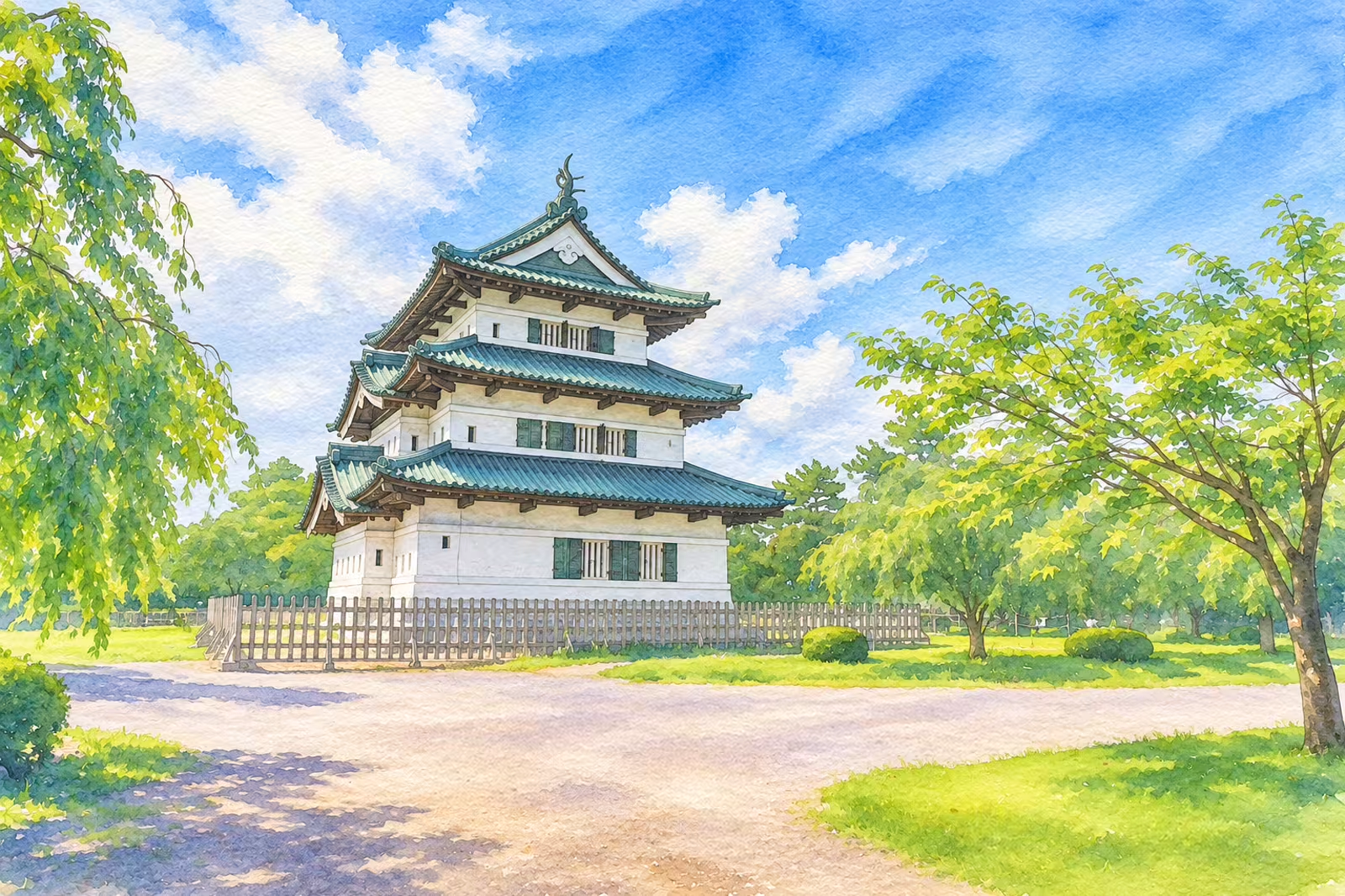
Hirosaki Castle stands in the city of Hirosaki in Aomori Prefecture. It was the seat of the Tsugaru family, lords of the Hirosaki domain, from its completion in the early 17th century until the end of the Edo period, roughly 260 years. The castle preserves an Edo-period keep, three turrets and five gates, and of the twelve keeps in Japan that survive from the Edo period or earlier, it is the farthest north. The grounds are now Hirosaki Park, best known for its cherry blossoms.
01Building the Castle
In the late Sengoku period the Tsugaru region nominally belonged to the Nanbu clan. Ōura Tamenobu broke away from the Nanbu, won recognition of his lands from Toyotomi Hideyoshi in 1590, and took the surname Tsugaru. Tamenobu planned a new castle on the Takaoka plateau but died before construction began. His third son, Tsugaru Nobuhira, started work in 1610 and had the castle largely finished in 1611. It was first called Takaoka Castle; when the town was renamed Hirosaki in 1628, the castle took the new name. Records say that some gates were moved in from older castles nearby to speed up the work.
The plan centers on the honmaru (inner bailey), wrapped by the ninomaru, sannomaru and further enclosures, with several rings of moats and earthen ramparts. Outside lay samurai quarters, merchant districts and temple streets.
02The Lost Keep and Its Replacement
The original keep, a five-story tower at the southwest corner of the honmaru, was struck by lightning in 1627. According to accounts, the fire reached gunpowder stored inside, and the keep burned along with other buildings. For nearly two centuries Hirosaki had no keep. In 1810 the domain built the present three-story tower, officially described as a rebuilding of the corner turret at the southeast of the honmaru. It is small, but its facades are treated differently depending on whether they face into or out of the castle, and it is a good example of late Edo castle building. After the Meiji Restoration the palace and other buildings were demolished, and the grounds opened to the public as a park in 1895.
03What Survives Today
The keep, the three corner turrets of the ninomaru and five gates, including the Ōte-mon, are original Edo-period structures designated Important Cultural Properties, and the castle site as a whole is a National Historic Site. The moats, ramparts and stone walls are largely intact. In 2015 engineers moved the entire keep to a temporary spot inside the honmaru so that a bulging section of the stone wall beneath it could be repaired. This was a conservation measure, not a dismantling. As of 2026, the wall repairs and the return of the keep to its base were still under way. The park holds more than 2,000 cherry trees, among them old trees planted in the Meiji era that still bloom.
Hirosaki Castle
01A Castle at the Top of Honshū
Hirosaki sits in the far west of Aomori Prefecture, on the plain of the Iwaki River, in the region historically called Tsugaru. The castle at the heart of the city was the seat of the Tsugaru clan, lords of the Hirosaki domain, from the early seventeenth century until the domains were abolished in 1871. For roughly two and a half centuries and twelve generations, the family ruled from here.
What makes Hirosaki unusual is what survives. The three-story keep (tenshu, the main tower of a Japanese castle) is one of only twelve keeps in Japan that date from the Edo period (1603–1868) rather than being postwar reconstructions, and it is the only one in the six prefectures of the Tōhoku region. Around it stand three corner turrets (yagura) and five gates, all from the original construction in the early 1600s, along with moats, earthen ramparts and stone walls that still trace the castle’s full plan. Most Japanese castles lost almost everything in the Meiji period or in the Second World War. Hirosaki kept a remarkable share of its buildings.
Most visitors, though, come for the cherry trees. The castle grounds, now Hirosaki Park, hold over two thousand of them, and when they bloom in late April or early May the moats fill with fallen petals. The story of how a frontier warlord’s fortress became one of Japan’s best-loved cherry blossom sites runs through the whole history of the place.
02Ōura Tamenobu Breaks Away
In the sixteenth century the Tsugaru region nominally belonged to the Nanbu clan, a powerful family based in what is now northern Iwate and eastern Aomori. Nanbu authority over Tsugaru, on the far side of the Ōu Mountains, was loose. One of the local lords there was Ōura Tamenobu (1550–1608), head of the Ōura family. His origins are murky; the domain’s later official genealogy traced the family to the courtly Fujiwara, a claim that rivals dismissed.
In 1571 Tamenobu attacked Ishikawa Castle and drove out Ishikawa Takanobu, the Nanbu kinsman who governed Tsugaru. Tradition says Takanobu died in the attack, though some historians argue he survived it by several years. Over the following years Tamenobu took one Nanbu stronghold after another, including Daikōji and Namioka, until by the late 1580s most of Tsugaru was his.
His decisive move was diplomatic. In 1590 Toyotomi Hideyoshi, who had nearly finished unifying Japan, besieged the Hōjō clan at Odawara and summoned the lords of the country to attend him. Tamenobu reached Hideyoshi ahead of the Nanbu and secured recognition of his hold on Tsugaru. The Nanbu protested that he was a rebel vassal, but the decision stood. Tamenobu took the name Tsugaru, and the bitterness between the Tsugaru and the Nanbu lasted until the end of the Edo period.
At the Battle of Sekigahara in 1600, Tamenobu sided with Tokugawa Ieyasu. His territory was confirmed, and he gained a small detached holding in Kōzuke Province, far to the south. The domain was assessed at 47,000 koku (a measure of rice yield used to rank lords), making it a minor house among the roughly 260 domains of the Tokugawa order.
03Building the New Castle
Tamenobu’s earlier seat was Ōura Castle; in 1594 he moved to Horikoshi Castle, a lowland fortress that was hard to defend and too small to house his retainers. In 1603 he ordered a town laid out on Takaoka, a raised terrace between the Iwaki River and the smaller Tsuchibuchi River, as the site for a new castle. He did not live to build it. His eldest son, Nobutake, died in Kyoto in 1607, and Tamenobu died there at the end of the same year (early 1608 by the Western calendar).
His third son, Tsugaru Nobuhira (1586–1631), succeeded him, and within a year faced a challenge from a faction backing Nobutake’s young son. Nobuhira survived it with the help of his connections to the shogunate. The shogunate formally approved the new castle in 1609, construction began in 1610, and the castle was essentially complete in 1611, little more than a year later. To save time, some gates were moved in from older castles in the region.
It was at first called Takaoka Castle. In 1628 the town was renamed Hirosaki, and the castle took the new name. Tradition holds that the name was chosen by Tenkai, the influential Tendai Buddhist monk who advised the first Tokugawa shoguns and whom Nobuhira had taken as his teacher.
The plan was ambitious for a domain of this size. The castle had six enclosures (kuruwa): the inner citadel, or Honmaru, and around it the Ninomaru (second enclosure), Sannomaru (third), Shinomaru (fourth), the Kita-no-kuruwa (northern enclosure) and the Nishi-no-kuruwa (western enclosure). Three rings of moats protected the core. Beyond the walls, samurai residences and merchant districts were laid out, and the domain gathered temples into clusters on the edges of town. The most famous, Zenrin-gai, is a long avenue lined with Zen temples, a group that could also serve as a defensive screen.
04The Keep That Burned
Nobuhira’s castle had a five-story keep at the southwest corner of the Honmaru, a striking statement for a lord of 47,000 koku. It did not last long. In 1627 lightning struck the keep. The fire reached gunpowder stored inside, and the resulting explosion destroyed the tower along with the Honmaru palace and several turrets. Its stone base still stands at the southwest corner of the Honmaru.
For almost two centuries afterward Hirosaki had no keep. Money was part of the reason, but politics mattered as much. The shogunate’s Laws for the Military Houses (Buke shohatto) restricted castle construction, and rebuilding a keep required permission that a small domain was unlikely to seek. The castle continued to function as the seat of government without one.
05Two Wives and a Hidden Heir
Nobuhira’s marriages produced one of Hirosaki’s best-known stories. After Sekigahara, Ishida Mitsunari, the general who led the losing side, was executed. Nobuhira’s elder brother Nobutake, who had known Mitsunari’s son Shigenari, brought Shigenari and his sister Tatsuhime north to Tsugaru and hid them. Tatsuhime became Nobuhira’s principal wife. Then in 1613, on Tenkai’s advice, Tokugawa Ieyasu gave Nobuhira his adopted daughter Matehime (also read Mantenhime), a niece of Ieyasu whose first husband, Fukushima Masayuki, had died. A link to the shogun’s house was too valuable to refuse. Matehime became Nobuhira’s principal wife, and Tatsuhime was reduced to secondary wife and sent to live at Ōdate, the Tsugaru holding in Kōzuke.
Nobuhira is said to have stopped to see her on his journeys to and from Edo. In 1619 Tatsuhime gave birth to a son. After her death in 1623, the boy was taken into the domain’s Edo residence and raised as heir. He became the third lord, Tsugaru Nobuyoshi, in 1631. So a grandson of Ishida Mitsunari, the Tokugawa’s great enemy, came to rule a Tokugawa-era domain. The episode has been retold in novels and on stage, and local tellings embellish it considerably, but the basic facts of the two marriages and Nobuyoshi’s parentage are well established. Matehime’s spirit hall stands today at Chōshō-ji, the Tsugaru family temple.
06Two Centuries of Domain Rule
Of the twelve Tsugaru lords who ruled from Hirosaki, the fourth, Tsugaru Nobumasa (1646–1710), is remembered as the domain’s great reformer. Ruling for more than fifty years, he invited scholars, promoted land reclamation, river works and forestry, and planted windbreak forests along the Sea of Japan coast. New rice fields pushed the domain’s real yield well above its official assessment.
Tsugaru was also a hard place to farm. Cold summers brought crop failures, and the Tenmei famine of the 1780s hit the domain with devastating force; by the domain’s own count, more than 100,000 people starved in about a year from late 1783.
From the late eighteenth century, Russian ships began appearing in northern waters, and the shogunate ordered Hirosaki and the Nanbu domain of Morioka to send troops to guard Ezo, present-day Hokkaidō. In return, Hirosaki’s official assessment was raised to 70,000 koku in 1805 and to 100,000 koku in 1808. The higher figure brought prestige but no new land, and the costs of the northern garrisons weighed heavily on the domain’s finances.
07The Keep of 1810
The keep that stands today was built by the ninth lord, Tsugaru Yasuchika, shortly after the domain’s promotion to 100,000 koku. Work began in 1810 and finished in 1811. Because the shogunate did not permit new keeps, the work was officially a rebuilding of an existing corner turret, the Tatsumi (southeast) yagura of the Honmaru, and the structure was registered as a three-story turret rather than a keep. In practice, everyone treated it as the castle’s keep.
It is small, about 14.4 meters tall, the lowest of the surviving three-story keeps, and it once had a long turret attached on its north side that was removed in the Meiji era. It also has a well-known quirk. The east and south faces, which looked out toward the town and the main gate, are dressed up: the first and second stories carry large gabled bay windows, which make the small building look grander than it is. The west and north faces, which looked inward over the Honmaru, have no gables at all, only plain rows of lattice windows. Inside, the timber and construction are no better than an ordinary turret’s. The builders put the effort where outsiders would see it.
The roof is covered in copper tiles rather than ceramic ones. Copper does not crack in hard frosts and sheds the region’s heavy snow, and over time it has weathered to a soft green.
Yasuchika’s reign also saw the old Nanbu grudge flare up. In 1821 a Morioka retainer named Shimotomai Hidenoshin, angered that the Tsugaru now outranked his own lords, plotted to ambush Yasuchika on the road home from Edo. The plan was betrayed and failed; he was later caught and executed. Under the alias Sōma Daisaku, he became the hero of popular storytelling and theater.
08From Castle to Public Park
When the domains were abolished in 1871, Hirosaki briefly became a prefecture before it was merged into Aomori Prefecture, with the prefectural office placed in the port of Aomori rather than in the old castle town. The castle passed to the army ministry, and in 1884 the Honmaru palace and other buildings were torn down. The former lord, Tsugaru Tsuguakira, asked to buy the site back; the army refused but allowed it to be used for public purposes, so the city applied to make it a park, with the Tsugaru family paying for its upkeep.
In 1895 the grounds opened to the public as Hirosaki Park. Soon after, the Imperial Japanese Army’s 8th Division was based in Hirosaki, turning the city into a garrison town, and in 1898 most of the Sannomaru became army arsenal land.
Through all this, the keep, the three turrets of the Ninomaru and the five gates survived. Eight of them were designated National Treasures under the prewar system in 1937 and became Important Cultural Properties under the postwar Law for the Protection of Cultural Properties in 1950; the ninth, the Sannomaru East Gate, was added in 1953. The castle site itself was designated a National Historic Site in 1952. No building records survive for the three turrets and five gates, but they are generally believed to date from the original construction of 1611, two centuries older than the keep.
09The Cherry Trees
The castle’s cherry trees are usually traced to 1715, when domain retainers brought twenty-five trees from Kyoto. The cherry blossoms visitors know today began after the castle lost its purpose. In 1880 a former retainer, Uchiyama Kakuya, planted twenty trees at his own expense in the neglected grounds, and in 1882 another, Kikuchi Tatee, planted a thousand Somei Yoshino. Kikuchi is better remembered as a founder of Aomori’s apple industry. Large plantings followed from 1903. An old tree near the Ninomaru East Gate is thought to be one of Kikuchi’s thousand and is billed as the oldest Somei Yoshino in Japan.
The first formal cherry-viewing festival was held in 1918, the forerunner of today’s Hirosaki Cherry Blossom Festival. Hirosaki’s park staff are known for borrowing pruning techniques from the region’s apple orchards to keep old cherry trees healthy and blooming, an approach often called the Hirosaki method. The petal-covered outer moat, the tunnel of blossoms along the west moat, and the keep framed by flowers with Mount Iwaki behind it are now among the most familiar images of spring in Japan.
10Moving the Keep
In the early 2000s, inspections found that the stone wall on the east side of the Honmaru, beneath the keep, was bulging outward and at risk of collapse. Repairing it meant moving the keep first.
In 2015 the city lifted the entire keep, about 400 tonnes, on jacks and slid it roughly 70 meters into the interior of the Honmaru onto a temporary base, without taking it apart. The move took about three months, drew crowds, and residents took part in rope-pulling. With the keep out of the way, the stone wall was dismantled stone by stone, recorded and rebuilt; the keep is then to be hauled back onto its original base and given its own conservation work. The project has continued in recent years. While the keep sat in its temporary spot, it could be photographed with Mount Iwaki directly behind it, a view that had never existed before.
11Walking the Castle
The usual way in is from the south through the Ōte-mon (also written Otemon), which became the main gate in the later seventeenth century. Like the other four surviving gates, it is a two-story turret gate: a passage below, a guardroom with firing ports above. The upper story sits unusually high, a feature often explained as allowing mounted warriors carrying spears to pass even when snow lay deep.
Inside, the Sannomaru holds the Hirosaki City Museum and a botanical garden. The Ninomaru South Gate and East Gate lead into the second enclosure, and its three corners are held by the surviving turrets: the Tatsumi (southeast), Hitsujisaru (southwest) and Ushitora (northeast) yagura, each a compact three-story tower.
The red Gejō Bridge leads to the Honmaru, and the view from here of the keep, the stone walls and the moat is the castle’s classic photograph. Inside the Honmaru, the southeast corner is where the keep stands and the stone-wall repairs have taken place, and the southwest corner holds the base of the original five-story keep that burned in 1627. On a clear day Mount Iwaki fills the western sky.
At the north end, in the Kita-no-kuruwa, stands the Kamenokō Gate, or North Gate. In the castle’s early years this was the main entrance: lords set out from here for Edo by the west-coast road. After the route to Edo was changed in 1665 to run south, the Ōte-mon gradually took over as the main gate and this became the rear gate. It is a heavy, unadorned gate. Tradition says it was moved here from Daikōji Castle, and the marks on its timbers are said to be scars from the fighting of the Warring States period.
Outside the park, the preserved samurai district of Nakachō to the north and the thirty-three temples of Zenrin-gai to the southwest, ending at Chōshō-ji, the Tsugaru family temple, carry the castle town’s layout into the present.