
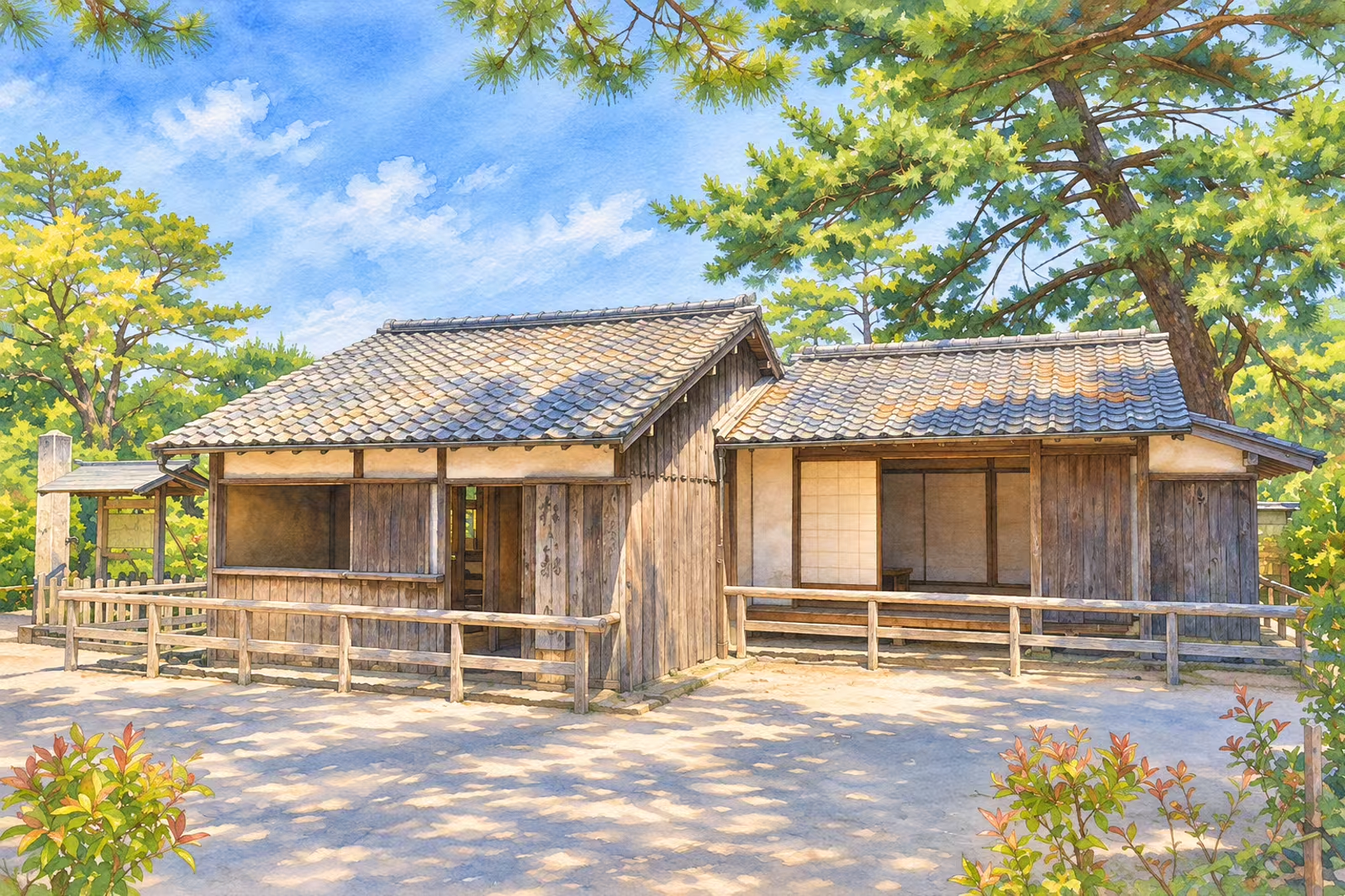
Hagi is a castle town on the Sea of Japan coast in northern Yamaguchi Prefecture, the seat of the Mōri lords of the Chōshū domain throughout the Edo period. Among the young men Yoshida Shōin taught at his small school, Shōkasonjuku, on the eastern edge of town were Takasugi Shinsaku, Itō Hirobumi and Yamagata Aritomo, who went on to play leading parts in the fall of the shogunate and the Meiji state. The street plan of the castle town survives largely intact, and the school and the town are two of five Hagi components of the World Heritage Site "Sites of Japan’s Meiji Industrial Revolution."
01The Mōri castle and town
After the Battle of Sekigahara in 1600, Mōri Terumoto’s holdings were cut from eight provinces in western Honshū to just two, Suō and Nagato. The Mōri chose Mount Shizuki, at the western tip of the delta at the mouth of the Abu River, for their new castle. Work began in 1604 and was finished a few years later, with the main compound at the foot of the hill and a final redoubt on the summit. The delta was divided into quarters for retainers and for townspeople, separated by waterways and earthen walls, and for about 260 years Hagi was the political center of the domain. The domain school, Meirinkan, was founded in 1718 and moved to a larger site in the middle of town in 1849. In 1863 the lord Mōri Takachika moved the domain government to Yamaguchi, and Hagi Castle was torn down in 1874.
02Yoshida Shōin and Shōkasonjuku
Shōkasonjuku began as a private school run by Shōin’s uncle, Tamaki Bunnoshin, and was later taken over by other relatives. Shōin had been punished for trying to leave Japan aboard an American warship, and from 1855 he was confined at his family’s Sugi house in Hagi. From about 1857 he ran the school himself, teaching for only about two years in all. He admitted students regardless of rank, and lessons ranged from the classics and history to current affairs, with teacher and pupils arguing together. In 1858 he was imprisoned again for opposing the shogunate’s foreign policy, and in 1859 he was executed in Edo during the Ansei Purge, at the age of 29 (30 by traditional count). Students such as Kusaka Genzui and Takasugi Shinsaku became core figures in Chōshū’s movement against the shogunate.
03What can be seen today
The single-story wooden school building survives within the grounds of Shōin Shrine. Both the eight-mat lecture room and the rooms added later are original, and the Sugi family house where Shōin was confined stands nearby. Of Hagi Castle only the stone walls and moat remain, inside Shizuki Park. In the former samurai quarter of Horiuchi and in Hiyako, earthen walls, gates and old houses survive in continuous streetscapes, designated as Important Preservation Districts for Groups of Traditional Buildings. In 2015 the Hagi castle town and Shōkasonjuku were inscribed on the World Heritage List together with the Hagi reverberatory furnace, the Ebisugahana shipyard and the Ōitayama tatara ironworks.