
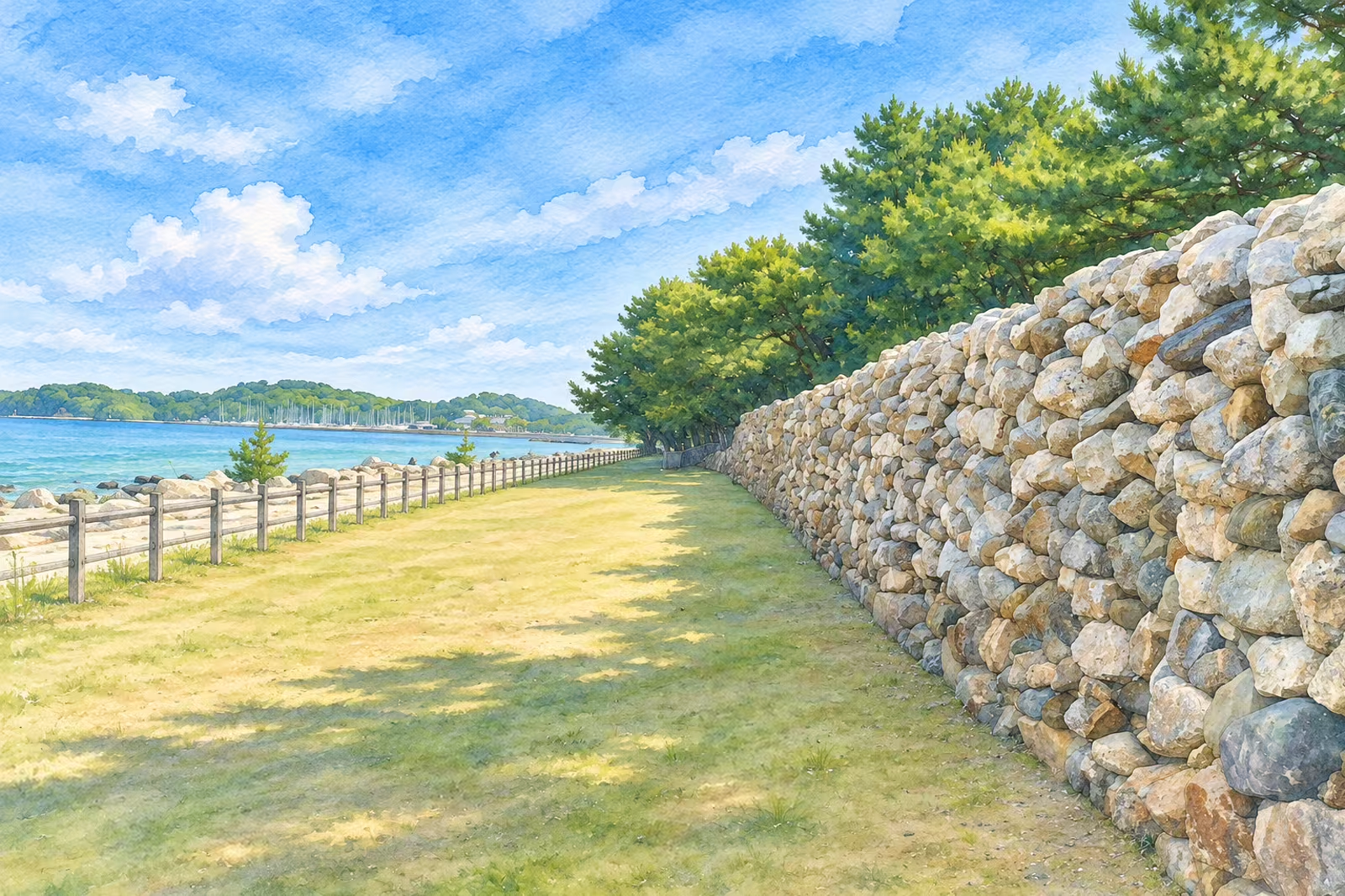
The Genkō Bōrui is the stone wall the Kamakura shogunate built along the shore of Hakata Bay, in present-day Fukuoka City, Fukuoka Prefecture, after the first Mongol invasion of Japan. Records describe it as running about 20 kilometers, from Kashii in the east to Imazu in the west, and when the invaders returned in 1281 it kept them from landing. Only scattered sections are visible today, but it remains one of the few large-scale medieval coastal defenses in Japan that can still be seen on the ground.
01Building the wall after 1274
In the tenth month of 1274 (Bun’ei 11), a combined Yuan and Goryeo force landed around Hakata Bay and fought the warriors of Kyūshū; the Hakozaki Hachiman shrine and other places were burned. The invaders soon withdrew, but the shogunate expected them to return. Besides tightening the guard on Kyūshū, in 1276 (Kenji 2) it ordered the provinces of Kyūshū to build a stone wall along the bay. Documents of the time call it ishitsuiji, "stone embankment"; the name Genkō Bōrui, "the defensive wall against the Mongol invaders," is a modern coinage.
Each province was assigned its own stretch of shore, and the labor and materials were levied on vassals and estates in proportion to their land holdings. The wall is generally thought to have been largely finished within the year. It stood about 2 meters high and 2 to 3 meters wide at the base, with a steep face toward the sea and a gentler slope on the landward side so defenders could climb it. Stone and technique vary from section to section, granite in some places, sandstone in others, some with an earth-filled core, which shows that each province built its part in its own way.
02The invasion of 1281
In the summer of 1281 (Kōan 4) the Yuan sent two fleets, the Eastern Route Army and the Jiangnan Army. When the Eastern Route Army reached Hakata Bay, the shore was walled and it could not land as it had seven years earlier. It occupied Shikanoshima and other points instead, and fought Japanese warriors at sea and on the islands. The Yuan forces later gathered near Takashima in Hizen, where a storm early in the intercalary seventh month wrecked much of the fleet and ended the campaign. The usual reading is that the wall’s value lay in holding the enemy off the beaches until the storm came. After 1281 the shogunate kept Kyūshū warriors on rotating guard duty, and repairs to the wall are said to have continued until near the end of the Kamakura period.
03What survives
As the shoreline moved outward and the city grew, most of the wall was buried. In 1931 the surviving sections were designated together as a national Historic Site. The best-known stretches are at Imazu and Ikinomatsubara in the west and around Nishijin in the city, including on the campus of Seinan Gakuin University. Some are excavated remains left exposed; others have been repaired or reconstructed on the original line. The rest of the wall now lies beneath streets and houses.