
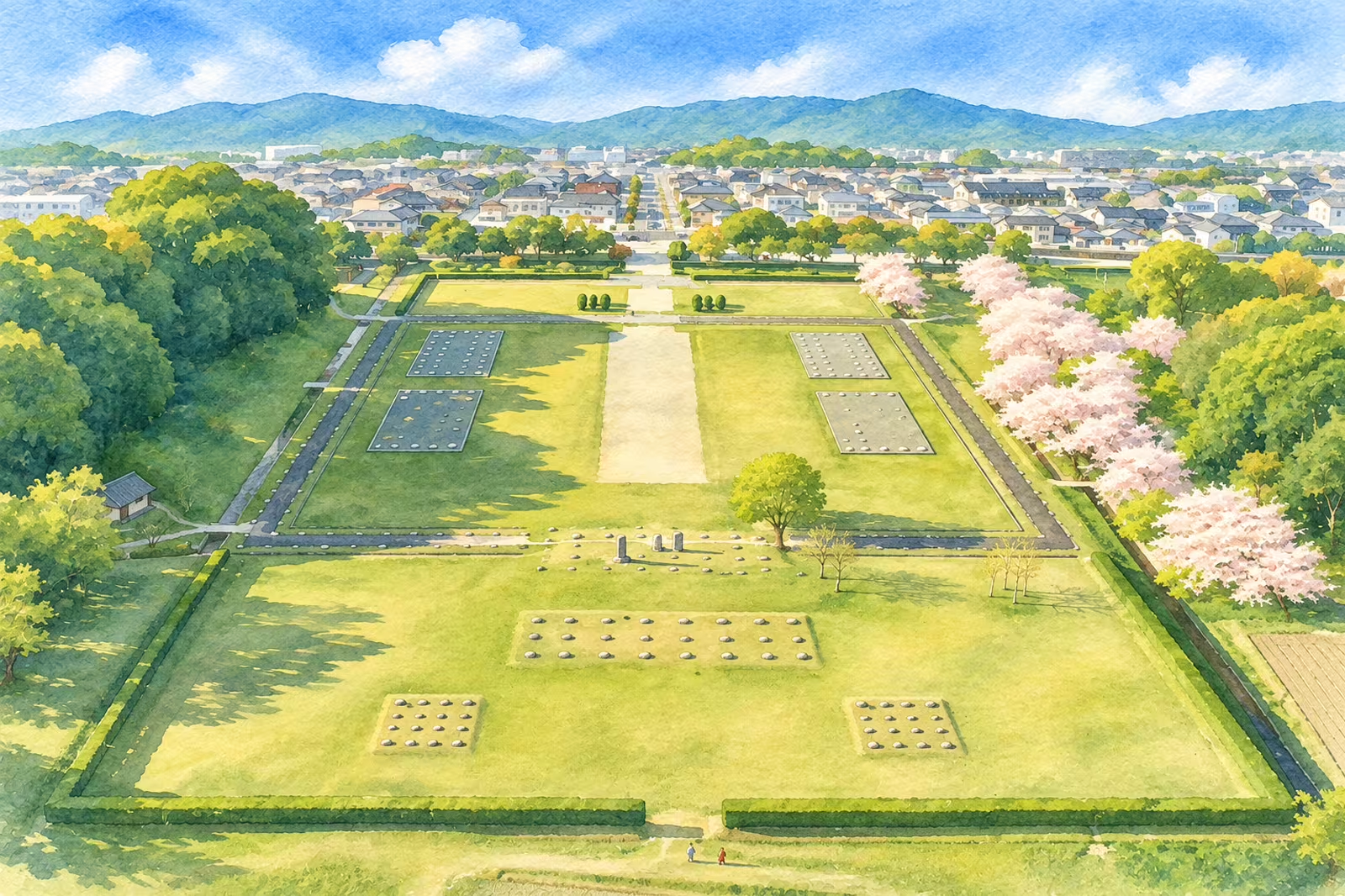
The Dazaifu Government Office Ruins, in Dazaifu City, Fukuoka Prefecture, mark the administrative core of ancient Dazaifu, the highest regional government of Japan’s ritsuryō state. From here officials governed the nine provinces and two islands of the Saikaidō circuit and handled diplomacy and frontier defense, which earned Dazaifu the name "the distant court." No ancient buildings survive, but the broad terraces and rows of foundation stones still show the size and layout of the complex.
01Founding and construction
After the defeat at the Battle of Hakusukinoe in 663, the court feared an attack by Tang China and Silla and fortified northern Kyūshū: the Mizuki earthwork was built in 664 and mountain castles such as Ōno Castle the following year. The Dazaifu administration took shape in the same period. Excavation shows three building phases. In the late 7th century the office consisted of buildings on earthfast posts. In the early 8th century it was rebuilt with tiled roofs and pillars set on foundation stones, following the plan of the court halls in the capital: a south gate and a middle gate opened onto a courtyard flanked by two subsidiary halls on each side, with the main hall at the north end. During the rebellion of Fujiwara no Sumitomo in 941 the office was burned, and it was then rebuilt at roughly the same scale. A grid of city blocks is generally thought to have spread south of the office.
02Dazaifu in history
Dazaifu received foreign envoys, oversaw contacts through the Kōrokan guesthouse, and served as a gateway for embassies to Tang China. In 901 the Minister of the Right Sugawara no Michizane was demoted to a nominal post here, and he died in Dazaifu in 903. His residence and his grave both lay outside the government office; the grave became Dazaifu Tenmangū. From the late 11th century real power drifted away from the institution, the office fell into ruin, and the site long served as farmland.
03What can be seen today
The ruins were designated a Historic Site in 1921 and raised to a Special Historic Site in 1953. Three stone monuments erected in modern times to commemorate and protect the site stand on the main hall platform. Most of the visible foundation stones belong to the third phase, after 941. The positions of gates, halls, and corridors are marked out on the ground, and no buildings have been reconstructed above ground. The adjacent Dazaifu Exhibition Hall preserves an excavated stone drain where it was found and displays a model of the office and excavated objects. Systematic excavation, begun in 1968, continues. Note the spelling: "大宰府" refers to the ancient government, while "太宰府" is the name of the modern city.