
Chihayaakasaka, on the western foot of Mount Kongō in southeastern Ōsaka Prefecture, is the only village in the prefecture. Its three castle sites, Chihaya, Kami-Akasaka and Shimo-Akasaka, are all connected with Kusunoki Masashige’s resistance to the Kamakura shogunate during the Genkō War of 1331–1333. In 1934 they were designated together as a National Historic Site under the name "Kusunoki Clan Castle Sites." There are no keeps or stone walls here; what remains are earthworks on mountain ridges and the commemorative tradition that grew up around Masashige.
01Kusunoki Masashige and the Genkō War
Masashige was a warrior of Kawachi Province whose birth year is unknown; he is generally thought to have come from the Chihayaakasaka area. In 1331, after Emperor Go-Daigo’s second plot against the shogunate failed, Masashige raised troops at Shimo-Akasaka Castle in his support. According to the Taiheiki, the castle was small and hastily built, yet it held off a large shogunate army for a time; before it fell, Masashige set it on fire to fake his death and slipped away. The following year he rose again and retook the Akasaka area.
In early 1333 the shogunate sent another large army. Kami-Akasaka fell after its water supply was cut, and Masashige withdrew to Chihaya Castle, higher on the slopes of Mount Kongō. The Taiheiki describes the garrison of about 1,000 holding off a besieging force said to number hundreds of thousands, using falling logs and stones, boiling water and straw dummies. The numbers and many details are clearly exaggerated, but it is generally accepted that Chihaya held out for months and tied down the shogunate’s main army. Meanwhile, revolts spread across the country. In the fifth month of 1333 Ashikaga Takauji took the Rokuhara office in Kyoto and Nitta Yoshisada entered Kamakura; the shogunate fell, and the siege of Chihaya was lifted.
During the Northern and Southern Courts period, the Kusunoki family kept the area as a base for the Southern Court, and Chihaya did not fall to the Northern side until the late 14th century. In modern times Masashige was promoted as a model of loyalty, and the area became a place of commemoration.
02What can be seen today
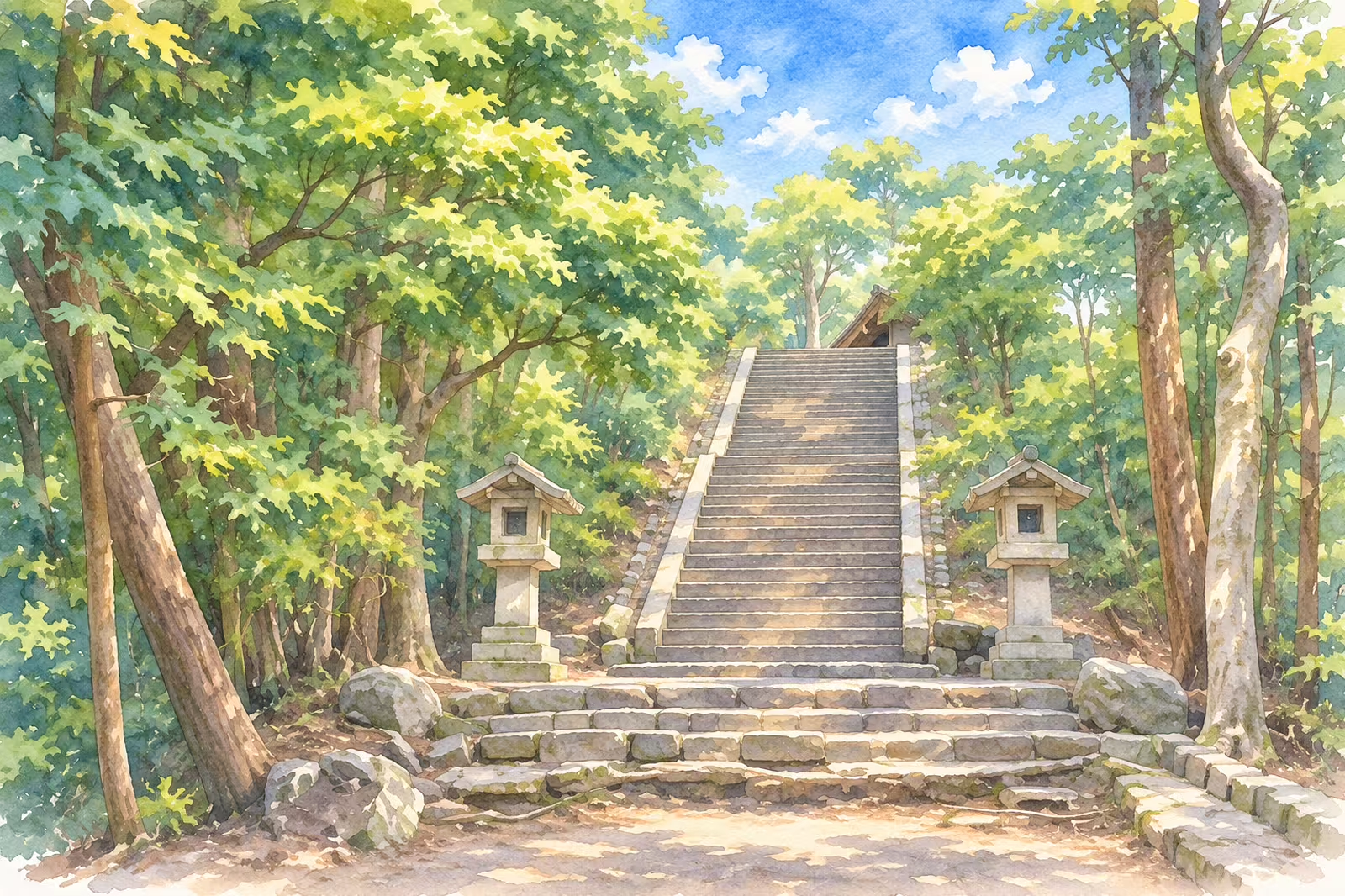
Chihaya Castle stands on a ridge at about 660 meters, surrounded by steep valleys. No buildings survive, but leveled baileys and terraces remain. The area of the second bailey is now occupied by Chihaya Shrine, dedicated to Masashige and others; the area behind it, thought to be the main bailey, is closed to visitors. Kami-Akasaka keeps its main and second baileys, dry moats and stepped terraces along a ridge, and has the clearest earthworks of the three. Shimo-Akasaka is harder to read; a marker stands at the site among terraced fields and houses.
Lower in the village is a memorial said to mark Masashige’s birthplace. Excavations nearby found a large medieval residence, but whether it belonged to the Kusunoki remains unsettled. A local history museum in the village presents Masashige and the castle sites.