
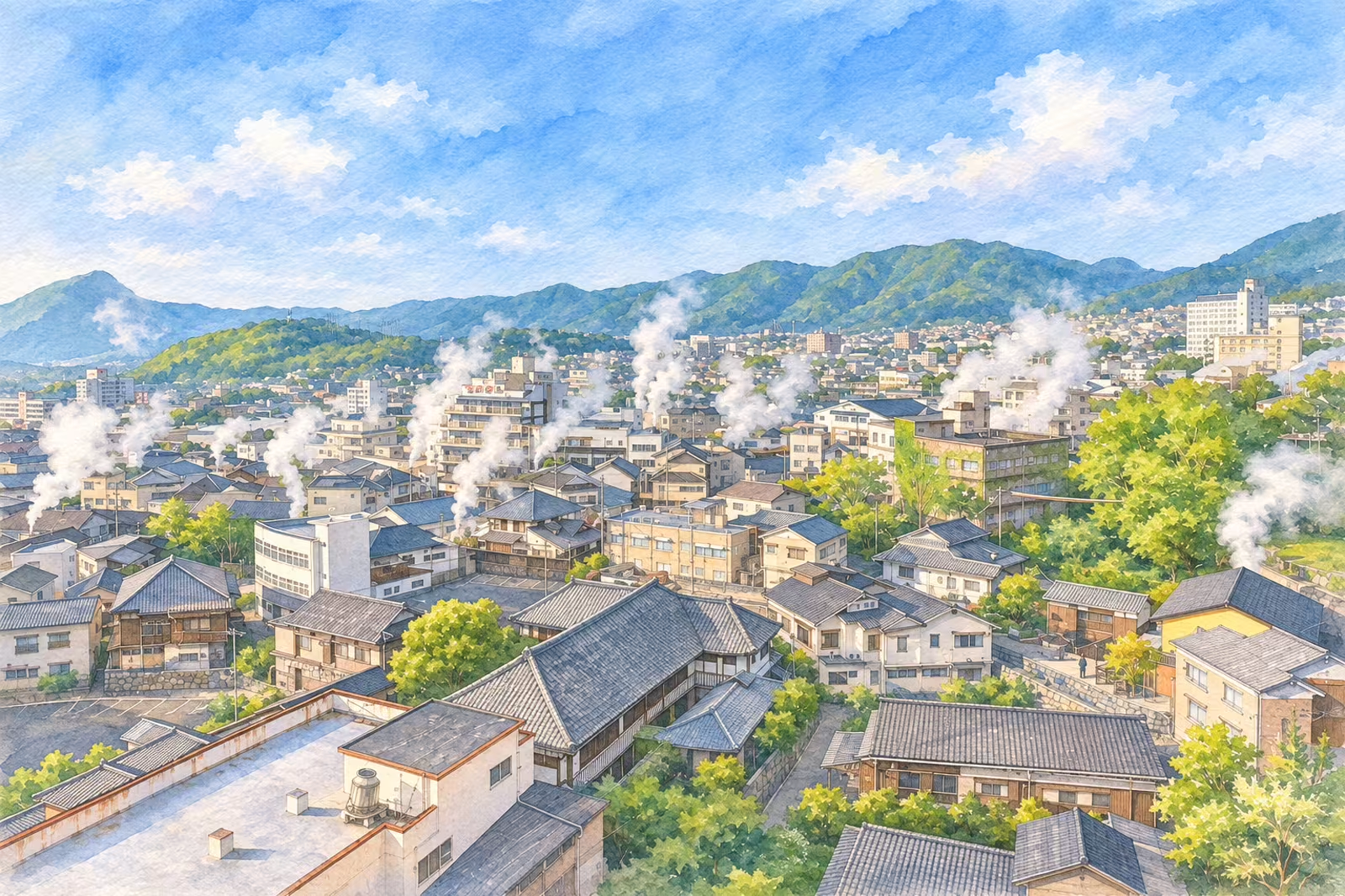
Beppu Onsen is the hot-spring city of Beppu in Ōita Prefecture, spread between the western shore of Beppu Bay and the slopes of Mount Tsurumi. It is generally regarded as having more hot-spring sources and a larger flow of water than anywhere else in Japan, with a wide range of spring types inside one municipality. Beppu as it exists today is a modern city built on that resource.
01Scattered spring villages, from antiquity to the Edo period
The springs appear in writing early. The Bungo no Kuni Fudoki, compiled in the 8th century, describes violently boiling springs in the area, usually identified with the jigoku ("hells") of present-day Kannawa. Local tradition holds that the itinerant monk Ippen restored steam baths at Kannawa in the Kamakura period, and he is still honored there as the founder of the springs. In the Edo period Hamawaki, Beppu, Kannawa and the other springs were separate, small villages used by farmers and travelers for healing baths.
The later name Beppu Hattō, the "Eight Springs of Beppu" (Beppu, Hamawaki, Kankaiji, Horita, Kannawa, Myōban, Kamegawa and Shibaseki), refers to these once-independent spring districts. The collective label became common only after they had merged into one city.
02Port, drilling and tourism after 1868
Work on a harbor began in the early Meiji years, and steamers from Ōsaka soon called regularly. From the middle of the Meiji period, the Kazusa-bori well-boring method from Chiba spread to Beppu, and the number of artificial wells rose quickly; records put the total at about 1,000 by the end of the Meiji era. Bathhouses, inns and convalescent facilities multiplied. The railway reached Beppu in 1911, and Beppu became a city in 1924.
In the Taishō and early Shōwa years, promoters such as the innkeeper Aburaya Kumahachi advertised Beppu nationally. They helped build the custom of touring the jigoku of Kannawa and Kamegawa, and launched sightseeing buses with women guides, said to be the first of their kind in Japan. Beppu changed from a spa for invalids into a nationally famous resort.
03What can be seen today
Takegawara Onsen, the best-known public bath, was founded in 1879; its present wooden building with a curved karahafu gable dates from 1938. Many small baths are still run by local residents. In Kannawa, steam rises from streets and rooftops, and in 2012 the Beppu hot-spring steam landscape was selected as an Important Cultural Landscape. Four of the jigoku, Umi, Chinoike, Tatsumaki and Shiraike, were designated a national Place of Scenic Beauty in 2009. At Myōban, thatched huts are still used to harvest yunohana, sulfur crystals from the springs, by a technique dating from the Edo period that is recognized as an Important Intangible Folk Cultural Property. Spread between the bay and the hills, these sites still show how Beppu grew out of several spring villages.