Skip to content
Chronicle

Search History Omakase

Start typing to search.

    Illustration for The Osaka Campaigns Destroy the Toyotomi House

    1614–1615 | Sengoku period

    The Osaka Campaigns Destroy the Toyotomi House

    大坂の陣

    Choose a reading depth

    Overview

    In 1614, a dispute over the inscription on the Hōkōji bell sharpened tensions between the Tokugawa government and Toyotomi Hideyori at Osaka. Mediation failed. The Toyotomi gathered rōnin, and Tokugawa Ieyasu and Hidetada mobilized their forces. The winter siege ended in a negotiated peace, followed by the filling of the castle's moats.

    In 1615, the Tokugawa demanded that the Toyotomi dismiss the rōnin inside Osaka Castle or that Hideyori leave Osaka. Fighting resumed. With its moats filled, the Toyotomi army fought outside the castle. Gotō Mototsugu died near Dōmyōji and Kimura Shigenari at Wakae. After defeat near Tennōji and Okayama, Osaka Castle burned; Hideyori and Yodo-dono died, while Hideyori's wife Senhime escaped.

    Accounts of the fall also record what happened to people inside the castle. In the later-published Okiku Monogatari, an attendant of Yodo-dono describes her own escape and says that she subsequently heard of women whose fate remained unknown. The account gives a view of the siege beyond its military outcome.
    Read The Osaka Campaigns Destroy the Toyotomi House

    Read the article below. Interactive reading tools are available when scripts load.

    Quick

    The Osaka Campaigns Destroy the Toyotomi House

    Hideyori lived at Osaka Castle with his mother, Yodo-dono. His marriage to Senhime, a granddaughter of Tokugawa Ieyasu, linked the two houses, but did not settle their struggle for power.

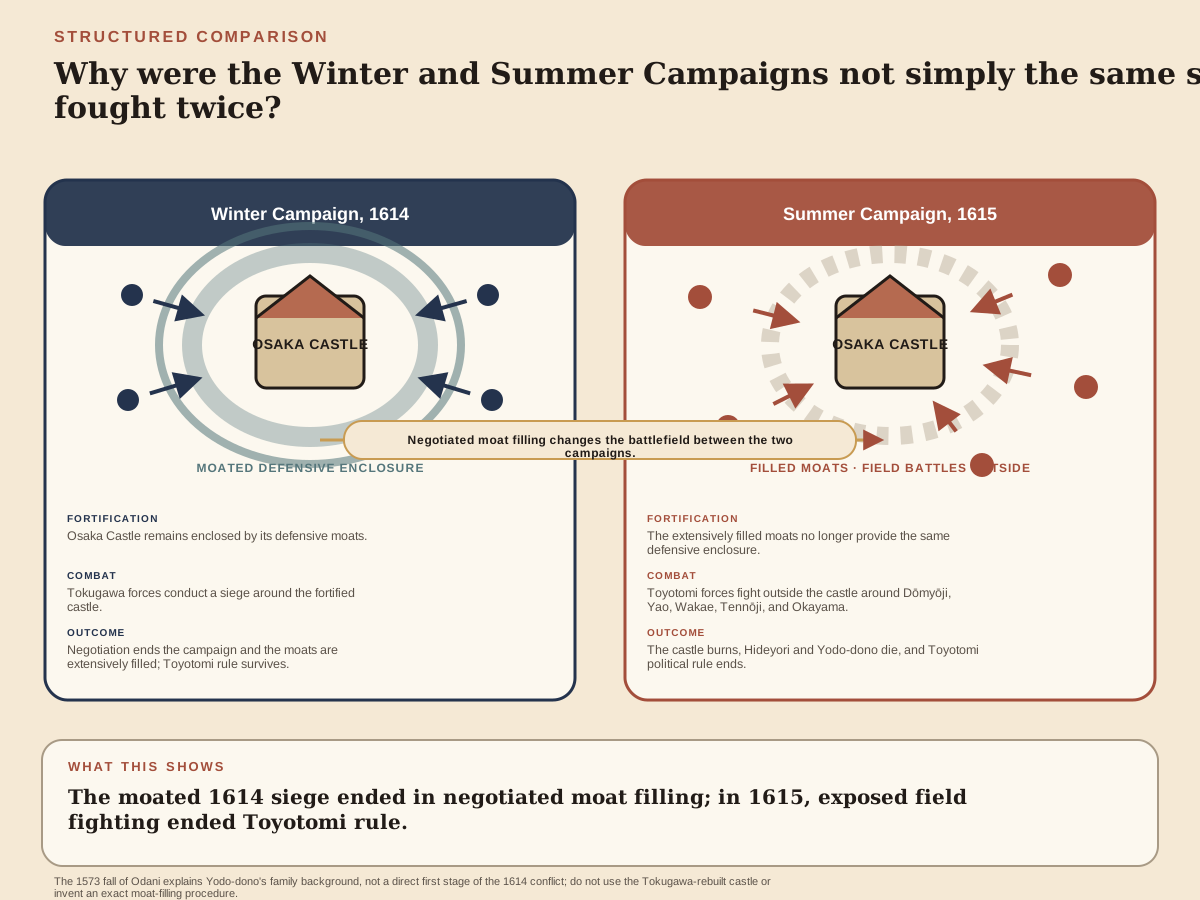
    In 1614, a dispute over the inscription on the Hōkōji bell sharpened tensions. After mediation failed, both sides prepared for war. The Tokugawa besieged Osaka in the winter campaign; peace followed, and the castle's moats were filled.

    In 1615, the Tokugawa demanded that the Toyotomi dismiss the rōnin or that Hideyori leave Osaka. War resumed. The Toyotomi forces fought outside the castle; Gotō Mototsugu and Kimura Shigenari died in the fighting. The final battles near Tennōji and Okayama ended in defeat. The castle burned. Hideyori and Yodo-dono died, while Senhime escaped.

    A later account by Yodo-dono's attendant Okiku describes her escape and the uncertainty surrounding women left behind. The defeat ended the Toyotomi house's independent political power. Tokugawa rebuilding later buried much of the earlier castle.

    Classic

    The road to the winter siege

    Toyotomi Hideyori lived at Osaka Castle with his mother, Yodo-dono, also known as Chacha. She was a daughter of Asai Nagamasa and Oichi, Oda Nobunaga's sister. Her sister Gō married Tokugawa Hidetada. These family ties crossed the political divide that later brought the two houses to war.

    Hideyori's 1603 marriage to Senhime, a granddaughter of Ieyasu, connected the Tokugawa and Toyotomi households. It did not remove the question of how the Toyotomi house at Osaka would stand in relation to the shogunate. In 1614, the disputed inscription on the Hōkōji bell became a focus of confrontation. Katagiri Katsumoto's efforts to mediate failed.

    The Toyotomi brought rōnin into Osaka, while Ieyasu and Hidetada mobilized lords for a campaign. Tokugawa forces besieged the castle that winter. Its defenders held out, including at the Sanada-maru outwork. A negotiated peace ended the siege, after which the castle's moats were filled.

    The summer campaign and the fall of Osaka

    The peace did not hold. After reports of renewed work on Osaka's defenses and the presence of rōnin, the Tokugawa demanded that the Toyotomi dismiss the rōnin or that Hideyori leave Osaka. The Toyotomi did not accept these terms, and fighting resumed in 1615. With the moats filled, they could no longer rely on the castle's former defenses and fought outside it.

    Fighting spread through the approaches to Osaka. Gotō Mototsugu died at Komatsuyama in the Dōmyōji area; Kimura Shigenari died at Wakae, amid fighting around Yao and Wakae. In the final battles near Tennōji and Okayama, Sanada Yukimura's force reached Ieyasu's camp, but could not reverse the defeat.

    Tokugawa forces took the castle. It burned, and Hideyori and Yodo-dono died. Hideyori's wife Senhime escaped. The Toyotomi household no longer held Osaka as an independent seat of power.

    Lives caught in the castle's fall

    The outcome is often told through the deaths of Hideyori and Yodo-dono. The surviving accounts also show what the fall meant for people around them. Senhime got out, but others inside the castle faced a dangerous and uncertain escape.

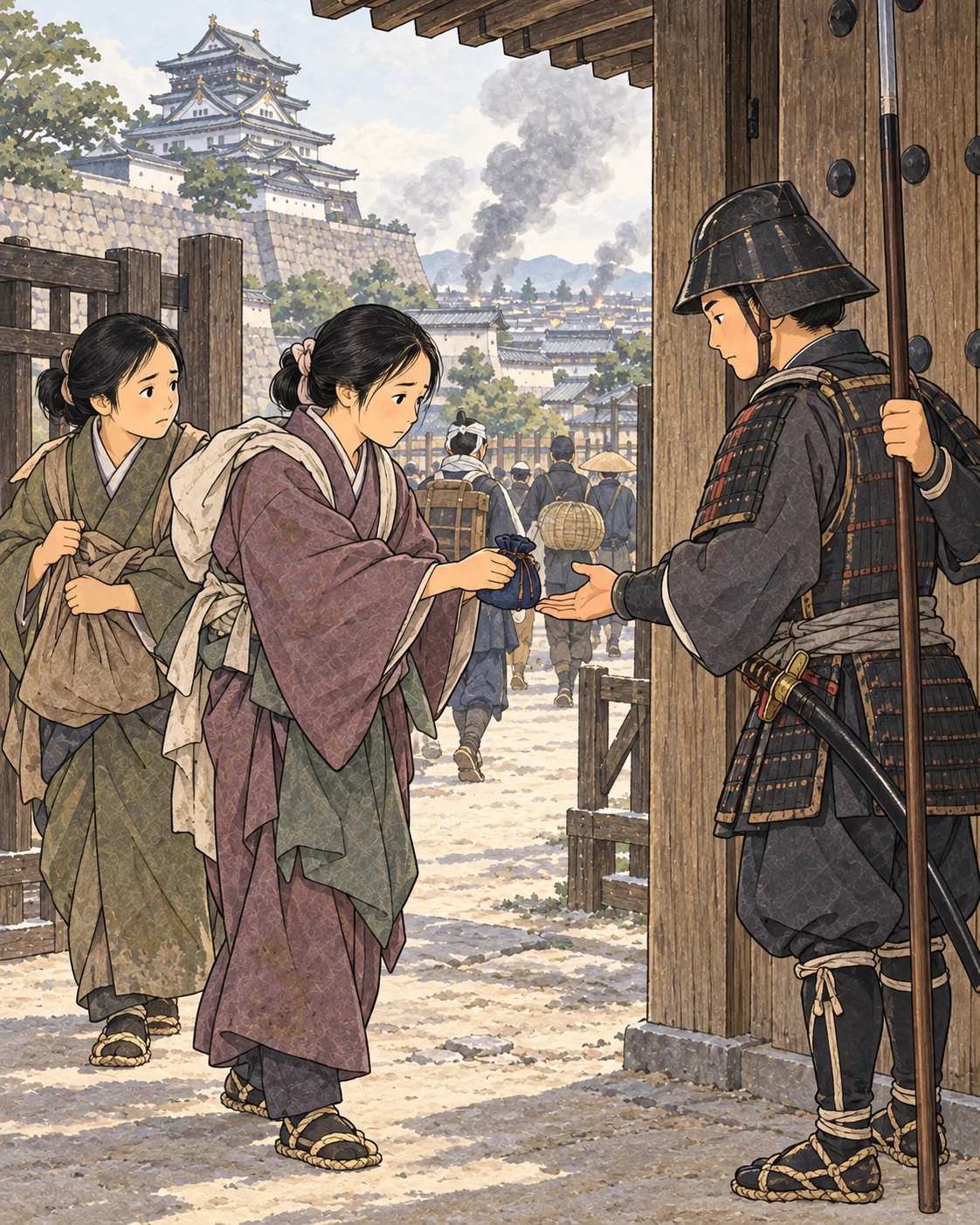
    In the later-published Okiku Monogatari, Yodo-dono's attendant Okiku recalls leaving despite a guard's warning. She gave up a piece of gold to get past an armed man and reached Yodo-dono's sister Hatsu. Okiku says she later heard that the fate of many women left behind was unknown. Her recollection describes one person's escape; it cannot establish what happened to every resident.

    A Tokugawa retainer's later account, the Mikawa Monogatari, describes people fleeing the fallen castle and reports the abduction of women and children. Its viewpoint and distance from the events matter. Read alongside Okiku's recollection, it records the human danger without turning either account into a complete tally of the dead or the displaced.

    Power and the castle after 1615

    The defeat removed the Toyotomi house at Osaka as a rival to Tokugawa rule. It also exposed the limits of the winter settlement: peace had ended one siege, while the dismantling of defenses left the castle in a different position when fighting resumed.

    Osaka Castle itself changed hands and form. From 1620, the Tokugawa built a new castle over the Toyotomi site, covering earlier stone walls with earth and new works. The walls and moats visible today largely belong to that later rebuilding, not to the castle that fell in 1615.

    Excavated Toyotomi stonework, including stones marked by fire, makes the earlier castle visible again. Together with accounts such as Okiku's, it gives later readers distinct kinds of evidence for the same event: material remains of the destruction and testimony about the people who lived through it.

    Sources and notes

    1. 大坂の陣 · Okamoto Ryōichi, Nipponica; Takagi Shōsaku, Heibonsha
    2. おきく物語 · National Archives of Japan
    3. 淀殿 · Hashimoto Masanobu 橋本政宣 / Yamakawa / Kōdansha
    4. 千姫の輿入れ · National Archives of Japan 国立公文書館
    5. 方広寺鐘銘事件・大坂冬の陣・夏の陣 · National Archives of Japan 国立公文書館
    6. 玉手山と大坂夏の陣 · Kashiwara City 柏原市
    7. 浅井三姉妹 · Nagahama official Sengoku-history presentation 長浜観光協会
    8. 千姫 · Hayashi Ryōshō 林亮勝 / Yamakawa
    9. 三河物語
    10. 豊臣石垣館
    11. まちの魅力:大坂夏の陣の勃発と戦闘経過
    12. 続・河内名所図会を訪ねて:大坂夏の陣と木村重成の墓

    About these sources

    Reading preferences

    Text size
    Glossary intensity

    Choose how much explanation appears as you read.

    Saved on this device. All terms remain available in the glossary.

    Browse the glossary →
    History Omakase

    Opening reading…