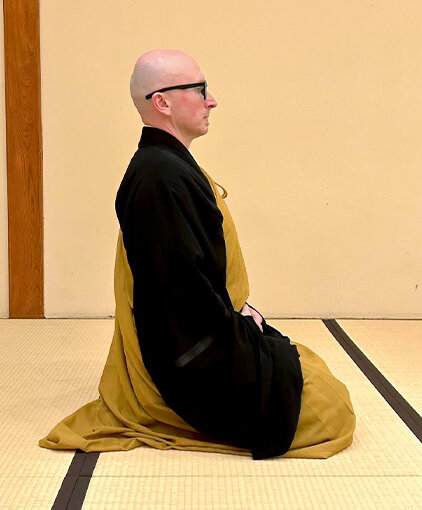
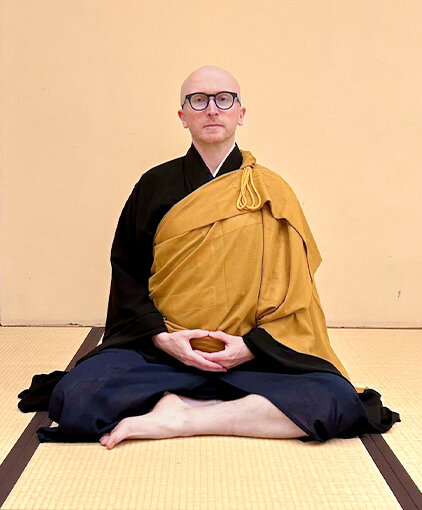
Zazen is seated practice within Zen Buddhism. Instructions address bodily posture, breathing and attention, while traditions differ in how they explain the practice and teach particular positions. Both the physical arrangement and its religious setting matter.
Sōtō teaching describes wholehearted sitting as shikantaza.
Rinzai training can include breath counting and kōan study with a teacher.
Follow the instructions of the particular temple or setting.
01
Body, breathing and attention
Support a balanced sitting position
The Sōtō guide places the zafu cushion beneath the center of the buttocks. Both knees and the buttocks provide three points supporting the upper body. It describes full lotus, with each foot on the opposite thigh, and half lotus, with one foot on the opposite thigh. The spine is extended without rigidity and the head balanced above it, with ears over shoulders and nose over navel. A side-to-side sway becomes progressively smaller until the body settles at the center. These instructions connect support, alignment and settling within this method; they do not require every person to force the same leg position.
Full lotus: each foot rests on the opposite thigh. Teaching photograph from Kōmyōji, Susono.Half lotus: one foot rests on the opposite thigh. Sōtō teaching photograph.
ButtocksSupported by the zafu
Both kneesForm three support points with the buttocks
Upper bodyBalances above this support
Sway from side to side, gradually reducing the movement and settling in the center. Sōtō practice illustration.
Hokkai-jōin and other hand positions
In the Sōtō guide’s hokkai-jōin, the left hand rests on the right, both palms upward, with the thumb tips lightly touching. The Rinzai temple Jingūji permits this arrangement or clasped hands, and Engakuji notes variation among Rinzai temples.
A close-up illustration of hokkai-jōin.Sōtō teaching photograph: left hand on right, thumb tips lightly touching.
Keep the eyes naturally open
The Sōtō instructions keep the eyes naturally open, neither widened nor narrowed, with the gaze lowered ahead. This accompanies the balanced head and upright torso described above, rather than dropping the head to follow the gaze.
Sōtō teaching photograph: balanced head and upper body, with eyes naturally open.
Counting and attending to the breath
The Sōtō guide begins with several deep breaths, then describes breathing through the nose with slow, attentive abdominal breathing while sitting. Rinzai teaching also uses methods such as breath counting; Engakuji’s Hakuin commentary connects arranging posture, counting breaths and kōan practice. These belong to their respective instructions.
Sōtō instructionsInitial deep breaths, then nasal breathing while sitting.
Rinzai temple teachingMay connect breath counting with posture and kōan work.
One to ten: a complete counting cycle
After discussing different counting methods, Engakuji teacher Yokota Nanrei’s 2023 article “Counting breaths” recommends counting exhalations in this instruction. Count one through ten, then begin again. If the number is forgotten, mistaken or goes beyond ten, restart at one. The instruction identifies what is counted, how the cycle repeats and how to return after losing count; it is not a rule shared by every Zen tradition.
1 → 2 → … → 10 ↺ 1
Count exhalations. Lost count, a counting error or going beyond ten → restart at 1. This is Yokota Nanrei’s Engakuji instruction.
A blank mind is not the instruction
The Sōtō guide advises sitting without being caught by arising thoughts, attending to the body and breath. Its teaching understands this sitting as practice itself. Engakuji likewise discusses body, breath and mind together. These are Zen instructions and interpretations of practice.
A thought arisesDo not cling to it
ReturnAttend again to posture and breath
Following the Sōtō practice guide.
Walking between periods of sitting
Between successive sitting periods, the Sōtō guide describes kinhin, quiet walking in the hall. One breath advances half a foot-length, and the next advances the other foot. Bells and gestures organize standing, stopping and returning to the seat, connecting walking with the sitting periods.
Sitting
Settle at the seat.
Standing
After two bell strikes, bow, move the body and rise as instructed.
Walking
Walk quietly with hands in shashu, coordinating small advances with breathing.
Stopping
After one bell strike, bring the feet together and bow.
Returning
Return to the seat and continue sitting.
The sitting–walking sequence in this Sōtō guide. The drawings show the poses at each stage; the text describes bowing and rising.
Left foot ahead: the feet are offset by about half a foot’s length.Right foot ahead next: alternate with small advances.
These top views show relative foot positions. In this guide, advance half a foot’s length with one breath, then alternate feet with the next.
Footprint detail from the original Sōtō practice illustration.
02
Different ways of explaining sitting
Wholehearted sitting
Sōtō teaching describes shikantaza as wholehearted sitting, rather than using sitting as an instrument to obtain a separate result. It connects the sitting posture itself with Buddhist realization and includes everyday conduct within practice. This is the tradition’s account of practice and realization.
Kōans and a teacher’s guidance
A kōan is a question, exchange or case taken up in Zen training, rather than a recreational riddle. Rinzai institutional history emphasizes Hakuin’s use of kōans, while Engakuji connects his sitting and breath-counting instructions with kōan work. The lay association Ningen Zen gives a concrete public description of sanzen: receive a case from a teacher, work on it while sitting, then present one’s understanding for the teacher’s judgment and further inquiry. This is a guided relationship, rather than finding a puzzle’s answer key; it does not establish one curriculum for every Rinzai temple.
Teacher in blue, practitioner in ochre: an HO schematic of guided practice, not identified people or a reconstruction of a particular consultation ritual.Inquiry in sitting practice: the posture shown does not prescribe the same curriculum or hand position for every group.
Receive a caseA teacher assigns it
Work on itInvestigate in sitting practice
Present understandingReceive assessment and further guidance
The teaching relationship described in Ningen Zen’s public glossary.
The setting can offer alternatives
Jingūji permits ordinary cross-legged sitting or kneeling when the legs hurt, using a folded cushion under the buttocks. Its next steps still have the upper body move and center above the lower body, followed by an extended back, a tucked chin and a downward-forward gaze. An alternative leg position thus remains within that temple’s instructions for support and upper-body balance, rather than replacing the rest of the positioning process.
Ordinary cross-legged sitting: feet remain low rather than on opposite thighs, with folded support beneath the hips.Supported seiza: knees forward, lower legs folded back and a folded cushion supporting the hips.
These alternative-pose drawings use the clasped-hand option allowed by Jingūji; they compare leg positions and support.
The folded cushion shown by Jingūji.Jingūji’s side view: support under the buttocks and upper-body posture.
A seiza example from a separate source: Sōtō teaching photograph.Sōtō’s Burmese-position example: both feet remain below the thighs.
A residential sesshin and an introductory meeting
Ningen Zen describes sesshin as staying at a dedicated dōjō for a period of repeated training under a teacher. Its glossary also describes samu through tasks such as cleaning and fieldwork, and kinhin as walking practice. Sitting, walking and work can thus form parts of communal training. This residential format differs from a short introductory sitting meeting; it does not mean every zazen event includes an overnight stay.
Sitting: seated practice at the dōjō.Walking can also be practice. This image identifies the activity without prescribing this group’s stride or breathing rules.Samu: cleaning is one example of daily work.
Activities that communal practice may include, shown side by side rather than as a fixed retreat timetable. Short introductory meetings do not imply a residential stay.
Ningen Zen sesshinStay at a dōjō for repeated guidance; communal practice can include sitting, walking and work.
A short introductory meetingA different format, without an implied residential stay.
03
Teaching develops through several traditions
More than one route from China
Zen traditions trace their religious lineage to the Buddha and Bodhidharma; such genealogies need to be distinguished from dated temple foundations. Rinzai institutional history describes several transmissions from China during the Kamakura and Muromachi periods. Eisai brought one of these lineages, rather than accounting for every Japanese Rinzai transmission himself.
Religious genealogyLineage traced to the Buddha and Bodhidharma
Historical transmissionsSeveral lineages entered Japan in the Kamakura and Muromachi periods
Thirteenth-century sitting texts
Dōgen (1200–1253), one of Japanese Sōtō’s founders, studied in Song China and wrote instructions after returning. A Sōtō publication dates the lost Karoku version of Fukanzazengi to 1227 and Bendōwa to 1231. Keizan and his successors later expanded Sōtō institutions and transmission.
1227The lost Karoku version of Fukanzazengi
1231Bendōwa
Dates discussed in Sōtō’s modern publication Dharma Eye, 2020.
Different Edo-period developments
The Chinese monk Ingen Ryūki arrived in Japan in the seventeenth century and founded Manpukuji in Uji in 1661, establishing the basis of the later Ōbaku tradition. In the eighteenth century, Hakuin Ekaku developed kōan teaching within Rinzai lineages. These were different developments, rather than one reform that standardized all Japanese sitting practice.
1661 · Ingen RyūkiFounded Manpukuji in Uji, a basis for the later Ōbaku tradition.
Eighteenth century · Hakuin EkakuDeveloped kōan guidance within Rinzai lineages.
Meiji to early Shōwa: dedicated places for lay practice
Lay practitioners remain in ordinary society rather than entering monastic life. Engakuji’s history links late-Edo rebuilding and renewal in the Tenmei era with Meiji communities of monks and lay practitioners around Imakita Kōsen and Shaku Sōen. Dedicated places followed: Ningen Zen’s history records the donated Takuboku dōjō in 1915, while Engakuji’s Kojirin was donated and moved from a Yagyū-school fencing hall in Tokyo’s Ushigome in 1928. These are concrete modern institutions for lay practice, not evidence that lay participation began only in Meiji.
1915Takuboku dōjō established through a donation.
1928Kojirin donated and relocated from a fencing hall in Ushigome, Tokyo.
A contemporary view of Engakuji’s Kojirin, shown on the temple website.
A postwar association: lay teachers and membership
Ningen Zen describes its postwar development as a lay association supported by membership fees and rules, with teaching and practice distinguished from administration and resource management. Its principles allow teachers to remain lay practitioners and describe a publicly available collection of two hundred selected kōans, the Gasenshū. These are the association’s own organizational and teaching arrangements, rather than a system used by every Sōtō or Rinzai venue.
Teaching and practiceTeachers may remain lay; the two-hundred-case Gasenshū is publicly available.
OrganizationMembership fees and rules, with administration and resource management distinguished from teaching.
Twentieth-century temples and Zen centers
Sōtō dates its overseas missionary activity in Peru and Hawaii to 1903. In 1959 Suzuki Shunryū arrived at Sōkōji in San Francisco, serving the Japanese-American community while attracting other participants to zazen. This community led to San Francisco Zen Center in 1962. Sitting, walking, chanting and shared work formed a communal setting for overseas practice.
1903Sōtō overseas missionary activity in Peru and Hawaii.
1959Suzuki Shunryū arrived at Sōkōji in San Francisco.
1962San Francisco Zen Center established.
The sitting hall pictured in Sōtō’s introduction to San Francisco Zen Center.Instruments pictured in the same introduction.
Continuing temple and lay practice
Engakuji now describes formats including a talk with sitting, dawn sitting, beginner meetings at Kojirin and online zazen. Kojirin’s role as a lay training hall links the earlier institution with continuing practice. Instructions from temples, traditions and university institutions differ; the particular setting supplies guidance beyond the shape of a posture in a picture.
In personTalks with sitting, dawn sitting and beginner meetings at Kojirin.
OnlineOnline zazen participation.
Formats described by Engakuji.
Check your understanding
Which hand is uppermost in hokkai-jōin?
In the Sōtō guide used here, the left rests on the right, palms upward, with the thumb tips lightly touching. That is not the only hand arrangement used in every temple.
What does shikantaza mean here?
Sōtō teaching describes wholehearted sitting, without treating it as a tool for obtaining a separate result.
Is a kōan just a riddle?
No. It is a case, question or exchange used in Zen training, connected with practice and a teacher’s guidance.
How does kinhin relate to sitting?
Quiet walking can take place between successive sitting periods, followed by a return to the seat.
What happens after losing count in the Engakuji counting example?
Restart at one, counting exhalations and repeating one through ten. This belongs to that particular instruction.
How does Ningen Zen’s public sanzen description connect sitting with a teacher?
A practitioner receives a case, works on it while sitting and presents an understanding for the teacher’s assessment and further guidance.
Does Kojirin’s relocation in 1928 date the beginning of lay zazen?
No. It dates the donation and relocation of a particular hall, not the beginning of lay participation.
Full-lotus photograph: Kōmyōji, Susono. Other posture photographs, kinhin and centering diagrams: Sōtō. Folded cushion and side view: Jingūji. Kojirin: Engakuji. Hall and instruments: Sōtō’s San Francisco Zen Center introduction. Date excerpt: Dharma Eye 46 (2020), printed page 9. The seiza and Burmese photographs are public image files retained in the teaching page’s source. Hand, alternative-pose and sitting–walking illustrations: HO. Alternative poses follow Jingūji’s folded-cushion instructions, with the supported-kneeling relationship referenced to the Zen Group of Western Australia guide.