JAPANESE CULTURE, EXPLAINED

Godzilla, 1954: building a monster film in images and sound

ゴジラ

Released on 3 November 1954, Godzilla is a black-and-white film directed by Ishirō Honda, with special effects led by Eiji Tsuburaya and music by Akira Ifukube. Its imagined disaster brings together nuclear-era fears, miniature environments, performance and carefully made sound.

01

The original film and its moment

Identify the original film

In the roughly 97-minute film, losses at sea lead to an investigation at Ōdo Island. Dr Yamane infers that nuclear tests have disturbed an ancient sea creature. After its attack on Tokyo, Serizawa’s oxygen-destroying invention offers a possible defence, but could itself become a devastating weapon. Saving people now risks enabling another means of destruction. This conflict belongs to the 1954 original, which should be distinguished from later films and overseas reworkings.
A contemporary fear becomes fiction

The March 1954 exposure of the Daigo Fukuryū Maru fishing boat to radioactive fallout forms part of the film’s context. Honda later connected the work with fear of the hydrogen bomb. The story is not a reconstruction of that incident: it develops its own threatened city, scientific dilemma and imagined creature.

02

Performance, miniatures, sound and music

An actor, a suit and a miniature environment

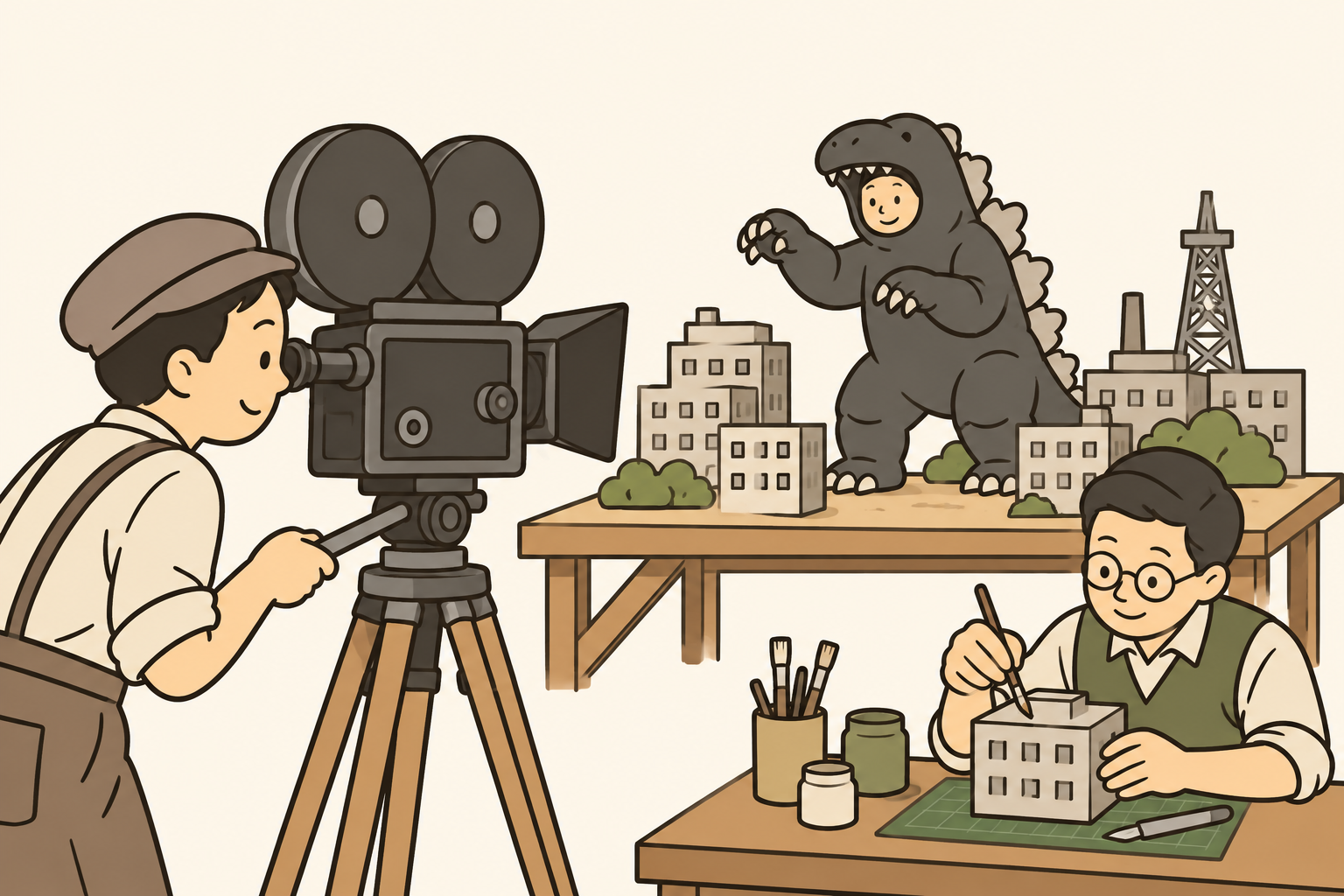
A performer inside a creature suit interacts with miniature buildings, scenery and destruction effects. The Agency for Cultural Affairs’ study of tokusatsu describes the collaboration behind designs, storyboards, model making and on-set operation. The impression of enormous scale depends on how these elements are photographed and performed together.

How effects contribute to screen scale
Design and shot planning
Suit performance + miniature environment + on-set effects
Photography establishes scale relationships in the image

A production relationship diagram, not a record or reconstruction of a specific 1954 shot.

A creature suit, miniature sets and camera work combine to create the screen image. A conceptual illustration, not a reconstruction of the 1954 set.

A roar made rather than simply collected

Otofuke’s Ifukube collection describes a resin-treated leather glove rubbed against a double bass, followed by tape processing, as part of creating the roar. The result was not a straightforward recording of one animal. It gives the creature an audible presence alongside footsteps, environmental effects and the score.

Different layers of film sound
Created roar and footsteps
Environmental sound within a scene
Score connecting scenes

Parallel layers brought together in a mix, not three successive manufacturing steps.

Music can connect separated scenes

A King Records interview with Kaoru Wada and Hisaaki Matsushita discusses a harmonica melody associated with the Eikō Maru that returns on cello when Serizawa’s secret weapon is disclosed. Such connections make the score more than accompaniment to monster appearances. The interview also distinguishes the original film mix from later concert presentation, which should not be treated as an unchanged reproduction of the soundtrack.

03

Versions and later screenings

The original, a reworking and restored screenings

Overseas circulation involved different versions. Criterion distinguishes the 1954 Japanese film from Godzilla, King of the Monsters!, Terry Morse’s 1956 reworking. Restoration is a different kind of change: the Paris Japan Cultural Institute presented a 4K restoration shown at the 2024 Berlin film festival. The later reworking and a restored presentation of the original should therefore be identified separately when discussing which images and soundtrack a viewer encounters.

Check your understanding

Does this article cover the whole franchise?

No. It concerns the original film released in 1954.

Are miniatures alone the special effect?

No. Performance, model work, photography, operation and sound contribute together.

Was the roar simply an animal recording?

No. Ifukube documentation describes friction on a double bass and tape processing.

Sources and images
  1. Toho: Godzilla collection
  2. Paris Japan Cultural Institute: Godzilla (1954)
  3. Agency for Cultural Affairs: special-effects report
  4. Wikipedia: Godzilla (1954)
  5. Godzilla official history: 1954 first film
  6. Ishiro Honda official site: Godzilla
  7. Otofuke library Ifukube room: creating the roar
  8. King Records Sound Fuji: Wada and Matsushita on the 1954 score
  9. Criterion: original Godzilla, 1956 reworking and restoration