JAPANESE CULTURE, EXPLAINED

Enka: vocal expression within modern popular media

演歌

Modern enka is a category within Japanese kayōkyoku, associated with narrative lyrics, emotionally shaped melodies and ornamented singing. Records, broadcasting, television and stages helped form it. Earlier street songs used the same word, but that shared name does not establish an unchanged genre.

01

Singing and a changing term

Ornaments shape a sung phrase

Kobushi involves brief upward and downward pitch turns. JOYSOUND’s explanation distinguishes it from regular vibrato and shakuri, a slide upwards towards a target pitch. These distinctions help identify vocal gestures; counting ornaments alone does not define enka. Singers also make choices in relation to words and individual works.

Vocal gestureBasic relationship
こぶしBrief up-and-down pitch turn
しゃくりSlide up towards a target pitch
VibratoRegular continuing oscillation
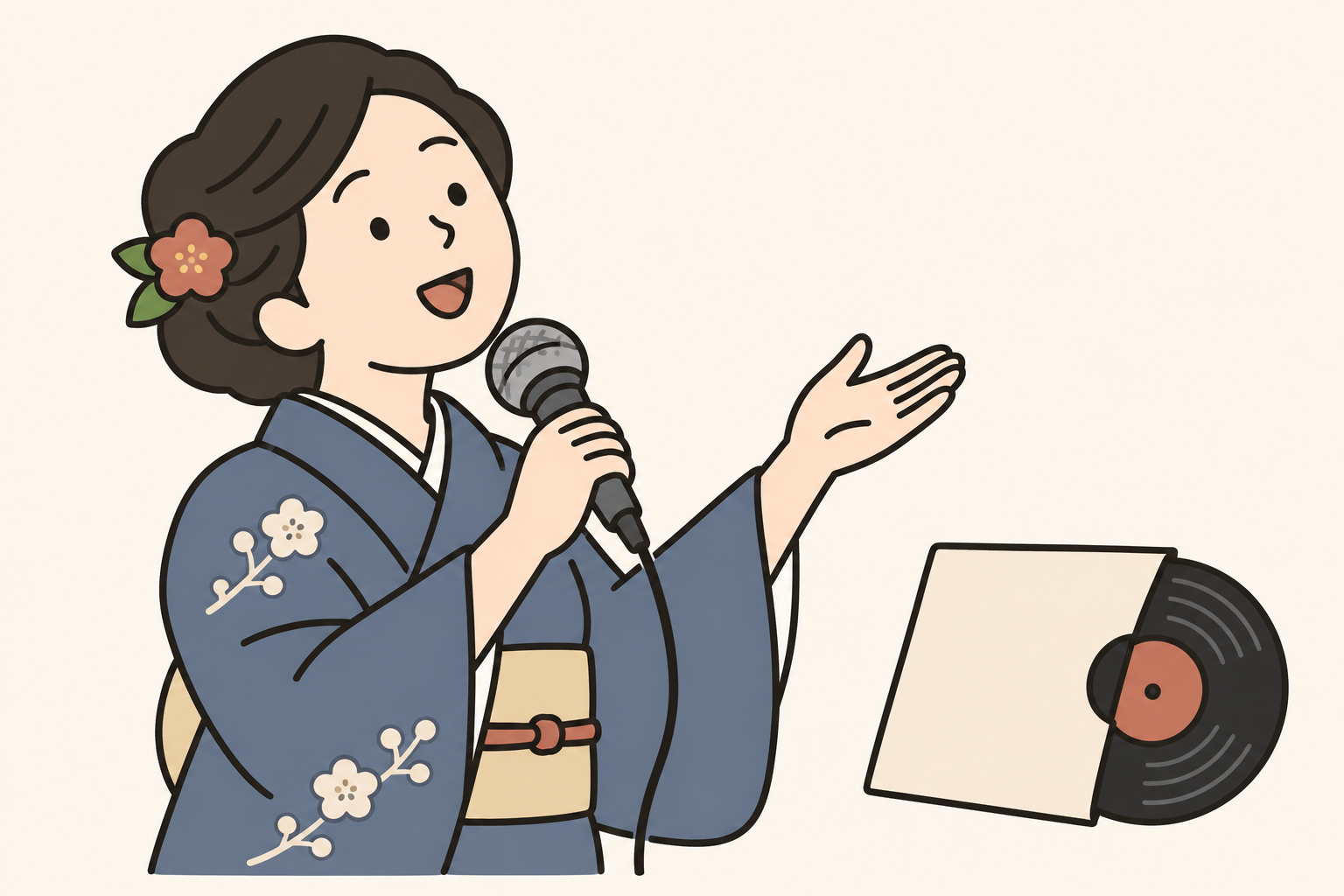
Singing and recorded music. An illustrative performance, not a portrait of a particular singer.

An older word acquired a new use

Meiji and Taishō street singers used songs for political statements and later sentimental subjects. Record-company popular songs expanded in the early Shōwa years, and broadcasting became an active producer after the war. Those media changes preceded the later genre label; the street songs were not an unchanged musical line. Yūsuke Wajima’s thesis abstract at the University of Tokyo traces a new use around 1965 for older-style commercial record songs. Criticism, fiction and performer images contributed to the developing category. The old name is evidence of changing usage rather than timeless musical continuity.

02

Songs, records and television

Three 1977 songs offer a concrete repertoire

Sayuri Ishikawa’s official retrospective identifies Tsugaru Kaikyō Fuyugeshiki, Noto Hantō and Danryū, released in January, May and September 1977. Aku Yū wrote the lyrics and Miki Takashi the music. Place names and travel imagery connect the songs, while the separate credits identify work beyond the singer’s performance.

Television and records shared songs

Hibari Misora’s Yawara appeared in 1964 as a television-drama theme and won the Japan Record Award the following year. The awards organiser recounts how other channels unusually picked up the song, carrying it beyond its original programme. Later anthologies select particular recordings: Columbia’s 2009 introduction uses the 1967 spoken-passage version of Kanashii Sake, rather than its 1966 original.

03

Singing again in karaoke

Karaoke makes another kind of participation

Karaoke combines lyrics, accompaniment, a microphone and pitch feedback. JOYSOUND can display detected kobushi, shakuri and vibrato, allowing a participant to revisit a phrase. Such scores describe a particular system’s response, not a final judgement of a song’s historical place or artistic value. Listening to records, attending a concert and singing oneself are different ways to take part.

Check your understanding

Is modern enka identical to Meiji political street song?

No. The word has described different practices at different times.

Is a singer automatically the lyricist and composer?

No. The particular song’s credits identify those contributions separately.

Does a high ornament count define enka?

No. Karaoke detection is not a complete genre definition or artistic judgement.

Sources and images
  1. University of Tokyo: Yūsuke Wajima’s enka thesis abstract
  2. NDL reference inquiry: changing uses of enka
  3. Wikipedia: Enka overview
  4. Sayuri Ishikawa: three songs from 1977
  5. Nippon Columbia: Hibari Misora recordings
  6. JOYSOUND: vocal ornaments and karaoke
  7. Japan Composer’s Association: 1965 Record Award and television circulation