JAPANESE CULTURE, EXPLAINED

Competitive karuta: hearing a poem and finding its final lines

競技かるた

Competitive karuta is a two-player contest using cards from the Ogura Hyakunin Isshu poetry anthology. Players listen to a reader and race for the matching card. The goal is to empty one’s own territory first, combining poem recognition with positional memory, judgement and movement.

01

Field setup and what players hear

One hundred poems, fifty cards in play

Reading cards contain complete poems; the cards on the floor carry only their final lines. Each player randomly takes 25 of the 100 playing cards and arranges them in three rows. The other 50 are absent from the field. A 15-minute memorisation period precedes play. This is neither a full 100-card set per player nor a turn-taking memory game.

Two territories, 25 cards each in three rows

Opponent’s territory ·25

Your territory ·25

Blank card shapes show counts and three-row arrangement only. Spacing is not to scale; players choose their layouts.

From the spoken poem to its card
Reader recites a poem
Identify it from opening sounds
Reach for its card in either territory

The reading card has the full poem; field cards have final lines. A karafuda has no matching card on the field.
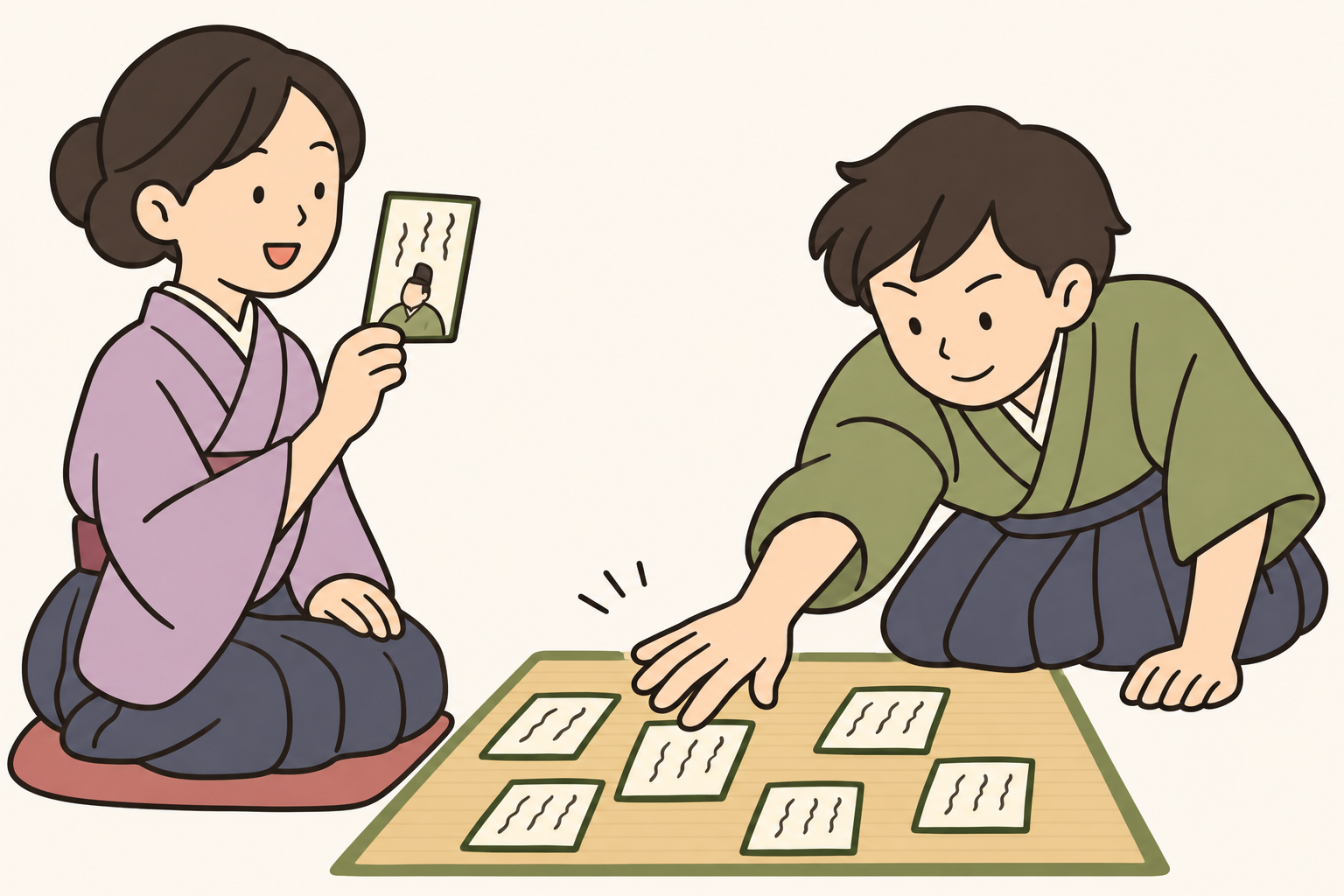
Listen to the reading, identify the playing card, then reach for it. The cards and their number are simplified.

Listen for enough sound to identify the poem

Kimariji is the opening sound sequence sufficient to distinguish a poem from those still relevant. A player can identify the target before the reading ends. As similar openings are eliminated, the point of recognition may change. Remembering the poem therefore needs to connect with the cards’ current positions.

02

Taking cards, faults and competition

An opponent’s card can reduce your own total

Taking the correct card in your territory removes it. Taking one from the opponent’s territory lets you send one of your own cards across. Both kinds of successful capture can bring your own territory closer to empty. Victory is therefore different from simply accumulating the largest captured pile.

Take target T from the opponent, then send your card S across
Before

Opponent · 25

T

You · 25

S
After taking T and sending S

Opponent · 25

S

You · 24

Off the field: captured target T

T and S are diagram labels, not real card faces. The transferred card’s position is one example, not a required replacement of T. The dashed gap shows one fewer card in your territory.

Faults depend on which territory is touched

A karafuda is a poem whose card is not on the field; touching a field card during its reading is a fault. When the target is present, touching another card within the same territory is not by itself a fault. Touching the territory without the target is a different matter. A fault normally lets the opponent send one of their own cards to the offender. The offender then has more cards to clear.

An anthology supports a modern competition structure

In 1904, Kuroiwa Ruikō unified differing regional rules, published methods for rapid capture and organised a competition. Wartime interruption was followed by revival and the establishment of the All Japan Karuta Association in 1954. Meijin title contests began in 1955 and Queen contests in 1957. The anthology predates these institutions, which also support graded and team competitions.

Check your understanding

Are all 100 playing cards on the field?

No. Each player starts with 25, for 50 in total.

Can a player touch a card during a karafuda reading?

No. Its matching card is absent; touching a field card incurs a fault.

How does taking an opponent’s card help empty your territory?

You may transfer one of your own cards to the opponent.

Sources and images
  1. All Japan Karuta Association: first steps
  2. All Japan Karuta Association: rules
  3. All Japan Karuta Association: overview
  4. Wikipedia: competitive karuta
  5. All Japan Karuta Association: history
  6. Hiroshima high-school federation: karuta rules
  7. Tokushima and Soga (2018): changing kimariji