Ban-sugoroku: a familiar board with different historical rules
盤双六
Ban-sugoroku uses two sets of pieces, dice and a divided board. Its equipment and actions resemble modern backgammon, but historical variants have their own rules. Picture-sugoroku, with illustrated route spaces, is a different kind of game.
01
Equipment and ways to play
Identify the equipment first
Tokushima Prefectural Museum describes twelve positions on each side of the board, twenty-four in total, with fifteen pieces per player and two dice. An 1842 inscription identifying a newly made set dates one set’s history rather than the invention of the game. An old board by itself cannot establish an unchanged ancient ruleset.
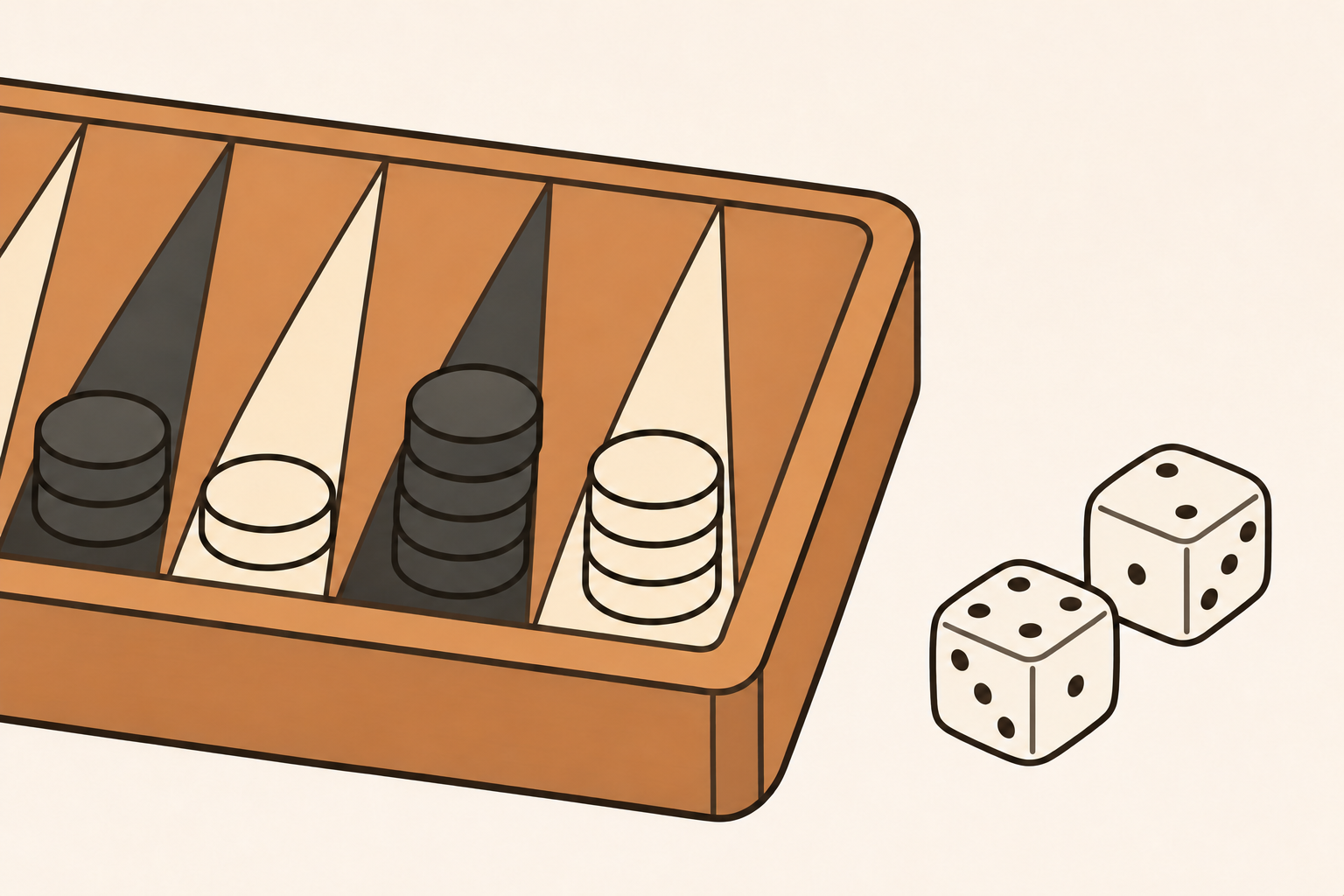
A board detail, black and white pieces, and two dice. An equipment illustration, not a complete starting position.
Use hon-sugoroku as a named example
The museum illustrates hon-sugoroku: dice govern movement; two or more opposing pieces block entry. A lone opposing piece can be hit, placed on the middle strip and subsequently re-entered according to the dice. Positioning and exposure of single pieces therefore matter alongside progress around the board. The players race in opposing directions towards their own home areas. In the study’s player-relative numbering, each begins with five pieces on point 6, three on 8, five on 13 and two on 24, totalling fifteen; the opponent’s arrangement is mirrored.
Hon-sugoroku setup: 15 pieces per colour
Upper row: Black → / White ←. Lower row: Black ← / White →. Turn between rows at the right end.
24
23
22
21
20
19
18
17
16
15
14
13
1
2
3
4
5
6
7
8
9
10
11
12
Numbers follow Black’s route from 24 down to 1. Black’s final six points are lower left; White’s are upper left. Schematic after Tokushima Museum figure 3 and Takahashi’s setup; not to scale.
The finishing condition distinguishes games
Hironori Takahashi’s study describes victory in hon-sugoroku when all pieces reach the final six positions. Modern backgammon then requires bearing the pieces off the board. Shared numbers of points and pieces do not erase this difference; other historical variants require their own explanations.
02
Display and other forms of sugoroku
Boards also have material and social histories
The Shōsōin exhibition identifies its decorated rosewood board among Nara-period treasures associated with Emperor Shōmu. An Edo board at Tamagawa University’s museum instead uses ivory inlay and lacquer decoration, with a possible bridal context; some pieces and its cup are missing. Early surviving equipment, later decorative uses and Edo accounts of play provide different kinds of historical evidence. Takahashi also traces references through the Nihon shoki, Heian works such as The Tale of Genji and The Pillow Book, and medieval texts including Essays in Idleness. Edo and Meiji writings name particular variants. This documents a long presence without settling every early rule.
Keep the two sugoroku forms distinct
Picture-sugoroku follows illustrated spaces on paper; board-sugoroku contests shared positions with multiple pieces. In the hon variant described here, a die supplies a move’s distance: a roll of three means counting three positions.
Check your understanding
How many pieces does each player have in this example?
Fifteen, with twenty-four positions on the board.
Must hon-sugoroku pieces all leave the board to win?
The cited study ends the game when all reach the final six positions, unlike modern backgammon.
Does the 1842 box inscription date the game’s invention?